Coordinated storage, converter, communication, and data-driven control of renewable-rich power systems rely on coordinated and integrated components, but performance under controlled conditions will not ensure long-term deployment value. The review is structured and based on journal publications from 2020-2025 to link the performance of the smart grid, resilience of power systems, lifecycle assessment, and reproducibility. It is a synthesis that is based on six stages of validation, five dimensions of lifecycle value, and 10 reporting criteria but does not estimate the prevalence of literature or give a quality score at the study level. Selected quantitative examples differentiate technology ranges, the assumptions used in the scenarios, and the outcomes of the modelling of the lifecycle. They show how the operating mode, degradation, capital-cost limits, and second-life allocation can affect the application of an efficiency benefit. In particular, projections based on operational information are different from longitudinal field validation. A laboratory-to-lifecycle approach is suggested for aligning the claims with the evidence to support them, while a milestone-based roadmap identifies priorities for reporting, implementation, and sustained operation. Technical performance, reproducibility, validation, resilience, and lifecycle assessment are complementary pieces of evidence; the central implication is. These contributions must all be assessed with respect to a specific grid service, system boundary, and operating horizon to make deployment decisions.
Research ArticleSmart Grids and Renewable IntegrationIn progress
From Laboratory Efficiency to Lifecycle Value: A Reproducible Research Roadmap for Smart Grids, Power-System Resilience, and Renewable Integration
Correspondence: rahmanshahriyar0048@gmail.com
Abstract
Keywords Smart GridRenewable Energy IntegrationPower-System ResilienceLifecycle ValueReproducibilityValidationEnergy Transition
1. Introduction
Research on renewable energy-integrated smart grids considers distributed generation, storage, metering, communication, and automated control as parts of a single smart grid. The resulting needs for interoperability, cybersecurity, and deployment readiness are demonstrated in industry applications [1] [2]. Long-term planning is used to tie these local capabilities to generation and transmission investment. Under conditions of uncertainty in renewables, storage and flexibility need to be coordinated, not planned independently [3]. One way to deal with the mismatch in time between production and demand is to store energy. The contribution will depend on the way stored energy is delivered to the grid to provide the grid service [4].
PV and wind power have a high share of variability and prediction uncertainty. These have an impact on the following: Balancing, Congestion, curtailment, and Reserve requirements [5]. This means that there is a loss of synchronous inertia, causing an extra control problem. As the generation mix evolves, converter-based voltage and frequency support is becoming significant [6]. The flexibility of charging EVs and vehicle-to-grid (V2G) operation becomes flexible demand and mobile storage. They are also incorporated, which alters the loading and reliability of the network, and flexibility needs to be considered in addition to the impacts on the system [7, 8]. The scope of the assessment boundary goes beyond operational gains. Sensorial, computing, storage, and power-electronic infrastructure also have embodied and lifecycle effects [9].
The engineering research has been addressed with ever more complex controllers, optimization techniques, forecasting models, storage strategies, and power-electronic interfaces. Timing studies are conducted in the laboratory to look at timing and device interactions, while storage studies are conducted to evaluate efficiency, response, degradation, and cost; forecasting studies are conducted to evaluate prediction error. Such literature, therefore, employs various metrics and test environments to assess technical performance [10, 11, 12]. The results obtained are promising in the range of experiments performed. During deployment, additionally, performance needs to be credible in the presence of model mismatch, communication delay, degradation of equipment, maintenance, interaction with protection, and environmental variations.
This difference results in a laboratory-to-lifecycle gap. The technical performance of an attractive system is not always accompanied by an attractive lifetime cost (when duty cycle, system size, replacement and degradation are taken into account) [13]. Environmental conclusions are also related to the location of the assessment boundary. An operational advantage can be understood differently by different manufacturing, electricity mix, recycling, and end-of-life assumptions [14]. In addition to normal operation, Resilience adds another source of value. Losses due to disruptions can be minimized with continuity of critical service and speedy recovery [15]. The lifecycle value of an innovation is therefore defined here as the contribution of the innovation in terms of durable technical, resilience, economic, environmental, and operational value over its service period in the power system.
A second gap is related to the reproducibility issue. Community benchmarking reveals that the structure of the model and the assumptions made in the model can have a significant impact on the results [16]. To recreate these outcomes, it is necessary to have identifiable data and explicit reuse conditions. Findable, accessible, interoperable, and reusable (FAIR) energy-data practice is the solution to these needs [17]. The practical issue is only half the problem, as it's open-source. The frameworks should also be usable, and the assumptions and implementation options should be understandable by other researchers [18, 19]. Computational reproducibility is the ability to replicate an analysis with a given set of data, models, parameters, and software. Independent testing is used to determine if the independent test's findings are consistent with the original testing when using different data, hardware, or operating conditions. These goals call for distinct evidence, and must be presented individually.
In this context, this review investigates potential ways to move smart-grid and renewable-integration research beyond controlled technical performance to evidence that is repeatable, replicable, resilient, and meaningful throughout the life of a deployed system. Current resilience reviews present definitions of disturbances and ways to enhance resilience [20]. The complementary evaluation needs are discussed in the literature of storage and reproducibility. The present review's contribution is to link these evidence streams together in a single laboratory-to-lifecycle logic. Specifically, the review:
Classifies smart grid technologies into systems, not devices;
Understands laboratory results and their relationship with the level of validation maturity;
Understands the value of resilience in terms of technical, economic, environmental, and operational lifecycle value; and
Recognizes the need for reproducibility to make credible comparisons; and
Creates a research roadmap based on a framework and milestones for converting controlled performance to deployment-relevant evidence.
2. Related Work
2.1 Smart Grids and Renewable Energy Integration
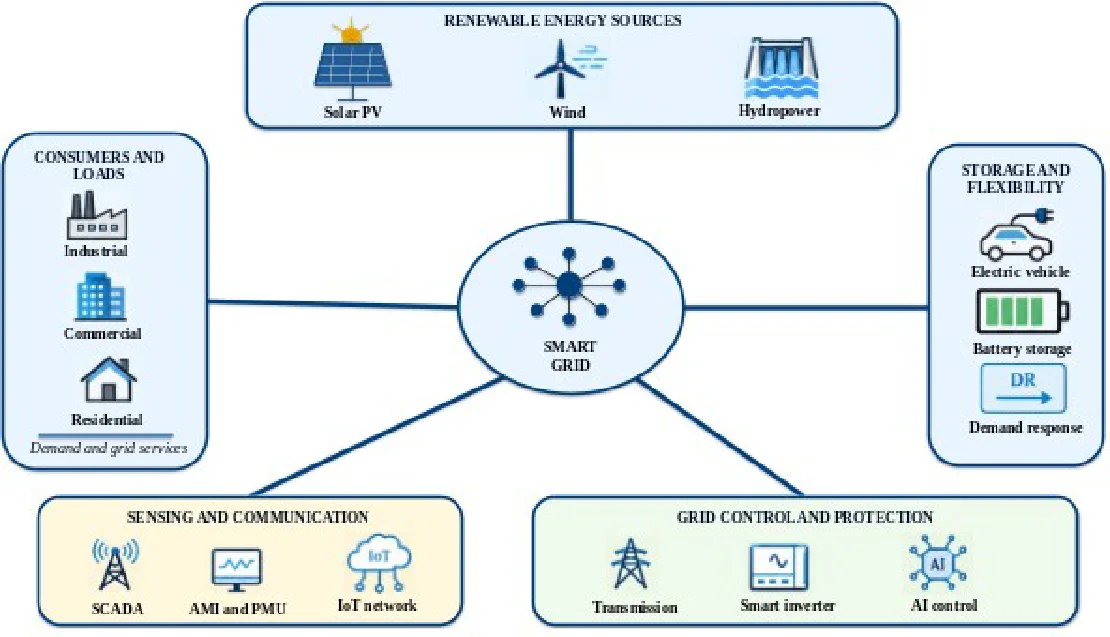
Smart grids offer the sensing, communication, coordination, and controllability necessary to manage networks with significant percentages of variable and distributed resources. The performance of their functions relies on the interaction of these functions on the network [21]. Energy is moved from one time to another by storage, and energy demand-side management changes energy consumption. They both offer temporal flexibility, but in different aspects of the supply-demand balance [22, 23]. Observability and coordination are achieved through advanced metering, supervisory control, and digital communication. These link the state of the system to the operation and control decisions [24]. The implications for planning in the bulk system were presented in Section 1. These functions come together in Figure 1, through a coordinating hub that connects renewable generation, consumer/loads, storage and flexibility, sensing and communication, and grid control and protection. Their interaction enables flexibility, stability, utilization of renewable energy sources, resilience, and lifecycle value.
2.3 Cost of Solar Energy: Challenges and Solutions
The integration of renewable resources brings up challenges that need to be addressed due to the integration of variable resources and constraints of the network. The impacts that they have on the architecture in which renewable generation is placed depend on it [25]. The need for coordination of generation, storage, converter control, and protection within a network is illustrated by an example of a direct-current microgrid. In addition to this physical integration problem, there are communication, planning, control, and interoperability constraints, and it is these components that create additional interactions [26, 27]. These balancing and low-inertia issues presented in Section 1 therefore need to be addressed at the system level.
The right answer is dependent on time and place. Flexibility is achieved by microgrid storage, controllable generation, and flexible loads, and demand response can be a part of microgrid flexibility during disruption. There are various ways to alter the relationship between supply and demand [28, 29]. A longer-duration problem is handled by seasonal storage. It can lower the renewable mismatch and curtailment even in the case of low round-trip efficiency [30]. These services will need to be coordinated with the generation and transmission decisions mentioned above. Evaluation should thus be based on the grid service provided and not just one single efficiency measure.
2.3 Power-System Reliability and Resilience
Reliability and Resilience are similar but not synonymous. Reliability is about what is expected to happen during normal operations and is about adequacy, while resilience is about being able to withstand and bounce back from disruption. So, a system-level assessment takes both generation and network and load into account and monitors preparedness, absorption, response, and recovery [31, 32, 33]. Disturbance space is expanded by the interacting effects of climate change and infrastructure, renewable availability, and demand. These dependencies are analyzed in complementary ways, through reviews of climate-related threats and through quantitative energy-system assessments [34] and [35]. Other disruption mechanisms are cyber-physical threats and cascading failures. These interactions are not adequately captured by the conventional measures of adequacy, nor are the implications for recovery [36].
Local generation, storage, controllable demand, and islanding can help keep the services of a microgrid alive during a crisis. The local capabilities are included in a larger suite of network enhancement strategies [37] and [38] that are the subject of a resilience review. Assessment needs to link the proposed intervention to the threat and vulnerability that it is intended to address. The holistic evaluation of microgrids and integrated reliability-resilience analysis are complementary methods to assessing mitigation and islanding decisions [39] and [40].
Operational research is the link between resilience and scheduling and planning decisions. These choices are explored in the context of hybrid-storage scheduling and climate-informed multi-year designs [41, 42]. Coordination is another level of decision-making. Microgrid-cluster planning, peer-to-peer trading, and graph-based learning for controlled islanding are also relevant to the question of how the distributed resources and structure of the grid can contribute to resilience [43, 44].
This is an additional operational requirement in the restoration. An evaluation of participation in photovoltaic-storage-charging stations in distribution networks under extreme weather has been carried out [45]. The length of service life is another factor to consider when choosing a resilient operating policy. In [46], the planning of microgrids is performed taking into account the battery life, associating disturbance response with the long-term impact of the equipment. These studies prompt a consideration of the outcomes of resilient service and lifecycle within a shared boundary.
2.4 Laboratory Efficiency and Validation
How a performance claim is validated can have a significant impact on the evidential meaning the claim has. Offline, real-time, co-simulation, and hardware-in-the-loop are types of advanced laboratory testing identified by the difference of the laboratory tests [10]. Adding a physical power interface introduces experimental limitations of power hardware-in-the-loop testing. Controller hardware-in-the-loop testing provides control implementations with real-time and hardware limitations [47] [48].
The more aspects of the physical and operational environment covered, the more mature the validation will be, but there is no one best stage. Comments from the participants on the benefits of using simulation compared to hardware testing included that simulation was used to explore the scenarios broadly with low experimental risk, while hardware testing added implementation realism at higher cost and lower scenario coverage. Pilot projects add realistic interfaces, operator constraints, and heterogeneous equipment; field deployment adds weather, communication quality, maintenance, and user behavior; and longitudinal evidence is required when claims involve degradation, replacement, or sustained economic value. The question is then whether the claim is as strong as the evidence offered by the validation stage.
2.5 Lifecycle and Techno-Economic Assessment
Lifecycle value assessment extends evaluation beyond the actual performance to the results of the ownership and operation of an asset over time. Techno-economic analysis is related to the technical characteristics, sizing, cost, and application context, while environmental life cycle assessment (LCA) focuses on impacts within an explicit functional unit and system boundary. These complementary methods are integrated through the use of assessment [49]. With second-life storage comes residual state of health, repurposing, and application suitability. The assessment includes material recovery and end-of-life allocation, which are included in recycling [50, 51].
Degradation is incorporated into primary studies for operational and planning decision-making. The second-life microgrid design incorporates residual asset condition and feasibility of the intended application in sizing the storage [52]. Scheduling extends the assessment to uncertain operation. The models that incorporate battery degradation and uncertainty of renewable resources consider the influence of these on dispatch decisions [53]. Some applications are related to agricultural energy management and stochastic operation of energy-constrained microgrids. Both relate the current operation to future battery state [54, 55].
Environmental assessment needs to be appropriately scaled to the storage technology. While battery research involves circularity and allocation of batteries for their lifecycle, pumped-hydro assessment is more focused on-site conditions and civil infrastructure [56] [57]. Technology reviews are done by comparing storage time, efficiency, siting, and suitability of application. There are more configuration and control options in hybrid systems [58, 59].
The bigger the context of the application, the more the system value depends on it. Geographic aggregation can help mitigate solar variability, and hence the mismatch flexibility resources have to deal with [60]. Now, the economics of storage needs to be analyzed for the target grid. The comparison is not based only on device properties, but on the operational savings of the devices [61].
2.6 Reproducibility and Research Gap
Reproducibility is the characteristic of whether or not the findings are reproducible on an independent basis. Explicit models, inputs, and access conditions are required in the benchmarking and FAIR-data requirements in Section 1. Understandability is an additional requirement: The user should be able to follow the assumptions and decisions made in the implementation of a result [19]. This is especially important if comparing studies with varying temporal resolutions, scenario designs, and system boundaries.
There are other reproducibility requirements for power-system studies. Synthetic distribution systems enable repeatable experiments without compromising utility data, which is sensitive [62]. However, data-driven applications require transparent dataset generation and data preprocessing since the results will be dependent on the scenario coverage and data distribution. Open power-quality dataset generators demonstrate the packaging of data creation, reference methods, and reusable workflows together [63], [64]. The contributions tackle various aspects of the evidence chain. It is a qualitative scope comparison of representative reviews to encourage their incorporation, not a scored assessment of the completeness of the reviews themselves, as shown in Table 1.
Table 1. Representative review scopes and the connections developed in this synthesis
| Study | Scope and approach | Relevant evidence coverage | Connection developed here |
|---|---|---|---|
| Khalid [21] | Smart-grid and renewable-integration review | Grid architecture, storage, flexibility and integration challenges | Link integration functions to validation and lifecycle evidence |
| Powell et al. [2] | Smart-grid challenges and applications | Industry applications, interoperability, security and future trends | Connect implementation challenges to a traceable evidence chain |
| Barrera-Singaña et al. [3] | Planning and optimization review | Generation, transmission, storage, flexibility and uncertainty | Relate planning boundaries to lifecycle and reproducibility requirements |
| Gharibvand et al. [28] | Microgrid flexibility review | Flexibility resources, metrics and storage effects | Connect flexibility metrics to claim-specific validation needs |
| Younesi et al. [20] | Power-system resilience review | Resilience concepts, metrics and enhancement strategies | Link disturbance performance to lifecycle consequences |
| Monie et al. [33] | Renewable-system resilience review | Resilience phases, metrics and nomenclature | Connect resilience phases to validation and deployment evidence |
| Montoya et al. [10] | Advanced laboratory-testing review | Real-time simulation, co-simulation and hardware-in-the-loop validation | Carry implementation evidence into lifecycle interpretation |
| Emrani and Berrada [11] | Techno-economic storage review | Technical performance, cost, sizing and renewable integration | Relate storage economics to resilience and reproducibility |
3. Methodology
3.1 Research Design
The present study is a structured critical narrative review of the heterogeneous engineering evidence regarding smart grids, renewable integration, resilience, lifecycle value, validation, and reproducibility. It's meant to link otherwise isolated evaluation practices and to create a claim-to-evidence system. Both reviews and primary research are included in the reference set. Reviews set up terms and create thematic context; individual numerical examples are interpreted in the context of the assumptions of the sources cited. Findings are synthesized thematically, as there is variation in technologies, services, baselines, disturbance definitions, economic boundaries, and time horizons. No claim for completeness of the systematic review, no meta-analysis, no formal ranking of the risk of bias, and no census of reporting practices are made.
3.2 Literature Scope and Discovery
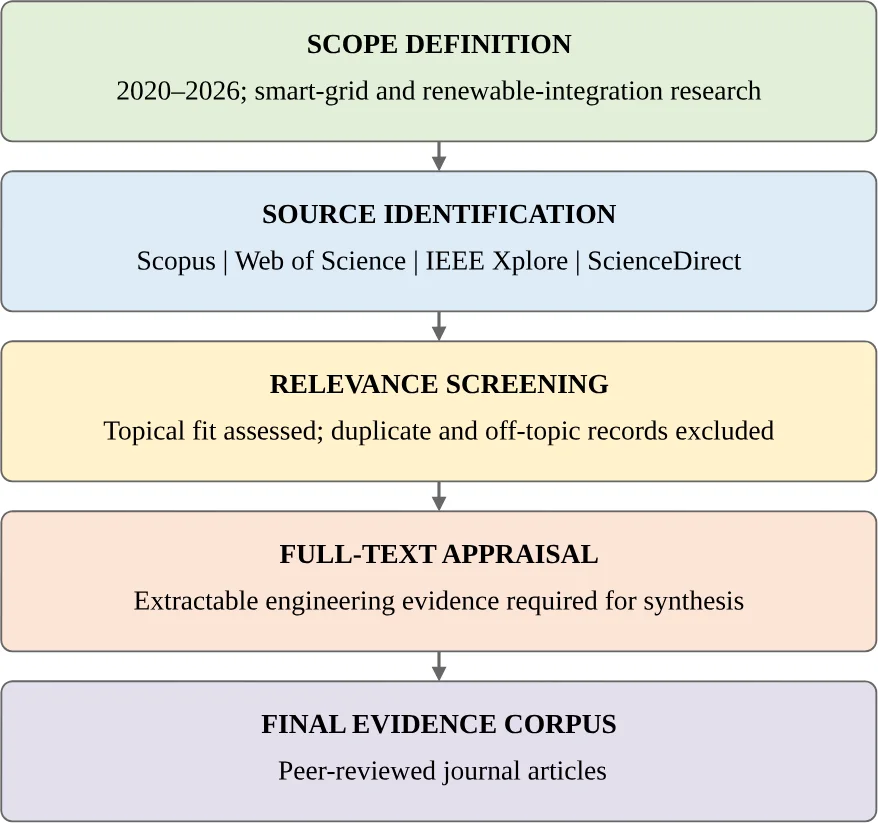
The literature-discovery scope covers English-language journal publications that are related to the smart-grid and renewable-integration research time frame of 2020-2026. The scope window is not intended to provide evidence of complete coverage to 2026, but rather is intended to reflect the years of the 80 publications cited in this version. The reported discovery resources are Scopus, Web of Science, IEEE Xplore, and ScienceDirect; publications are identified using DOI and publisher. The concepts of the search include the integration of renewables into smart grids, resilience, lifecycle and techno-economic assessment, and reproducibility or validation. There is no independent reconstruction of any database-specific query strings, execution dates, or screening logs. The reference set is therefore considered to be a non-exhaustive thematic collection, and the search concepts are not a retrospective reconstruction of a search protocol, but merely descriptions.
Table 2. Review scope, analytical framework, and reporting limits
| Review element | Specification |
|---|---|
| Discovery resources | Scopus, Web of Science, IEEE Xplore, and ScienceDirect are reported discovery sources; a database-specific search log is not supplied. |
| Publication scope | 2020–2026 scope; 80 cited journal publications dated 2020–2025. Coverage is non-exhaustive. |
| Search concepts | Smart grid; renewable integration; resilience; lifecycle and techno-economics; validation; reproducibility. |
| Source roles | English-language journal reviews for thematic context and primary studies for bounded examples; adjacent applications require explicit transfer limits. |
| Cited reference set | 80 distinct publications. This count does not represent 80 independent experiments or 80 completed appraisal records. |
| Validation stages | Offline simulation; real-time/co-simulation; HIL (CHIL/PHIL); pilot; field deployment; longitudinal operation. |
| Lifecycle dimensions | Technical; resilience; economic; environmental; operational and deployment. |
| Reporting criteria | Data provenance and access; model identification; parameters; software versions; code availability; baseline; uncertainty; validation procedure; lifecycle assumptions. |
| Synthesis and limits | Critical thematic synthesis with source-specific numerical examples; no pooled effects, criterion frequencies, or weighted quality score. |
3.3 Relevance Criteria and Source Roles
The synthesis is based on journal articles that are relevant to electric-power systems or directly relevant methods for energy modelling, environmental assessment, or reproducibility. Contextual information, like transferring LCA from adjacent applications (electric-vehicle battery LCA to stationary storage), is not considered direct deployment evidence. Cited references do not include conference papers, standards, reports, or preprints. Both reviews and primary studies are included, but in different ways – the review-level observations can be used for themes, and the source-specific numerical examples are used for bounded comparisons. Two separate reviews of the same result are not considered to be two independent replications. A lack of an article in this purposive collection does not mean that it has not passed a documented systematic screening procedure.
3.4 Evidence Selection and Corpus Definition
The references cited are 80 different journal articles. This is a bibliographic count rather than a count of independently validated experiments or of studies which meet all appraisal criteria. In Figure 2, the desired flow of the discovery-to-relevance assessment process and to inclusion is shown. The number of retrievals, deduplications and exclusions cannot be reported as there is no auditable screening log. The diagram thus simply records the review logic and not an audit of the database selection that can be reproduced.
3.5 Analytical Dimensions and Reporting Criteria
Each of the examples discussed is distinguished by the synthesis of the grid function, performance claim, validation environment, lifecycle boundary, and transparency. The categories of validation are as follows: offline simulation, real-time simulation and co-simulation, hardware-in-the-loop (HIL) test, pilot demonstration, field deployment, and longitudinal operation. Note that when applicable, HIL is broken down into Controller HIL (CHIL) and power HIL (PHIL). Validation is not just a stamp of approval on a whole publication; it's evidence in support of a specific claim. In particular, a model-based prediction made using observed data for the input parameters should not be considered model-based evidence unless it is verified against the proper observations for a decade of predictions. Technical, resilience, economic, environmental, and operational/deployment factors are taken into account when considering lifecycle value. Ten reporting criteria are used for reporting data provenance, data access, model identification, parameter completeness, software versions, code availability, baselines, uncertainty, validation procedures, and lifecycle assumptions. They provide interpretation guidance here, and do not state that they have a compliance percentage or a completed publication by criterion coding matrix.
3.6 Evidence Synthesis
Thematic synthesis enables the connection of grid functions with performance metrics, the necessary validation, and lifecycle implications. Comparisons of examples are only made when it is meaningful in terms of service objective, baseline, units, and system boundaries. All numerical values are identified as reported ranges, scenario assumptions, and/or model outputs; no values are combined across studies. Values from the cited source plot were digitized from the figure and rounded to the nearest kWh for annual values in Figure 6. To prevent inconsistencies between the percentages in the source's baseline and second-life values, the percentage values in Figure 8 were recalculated as percentages of the value displayed in the source. The framework and roadmap are an interpretation of the review; terms like 'validation gap' or 'reporting gap' refer to evidence needs identified in the review and are not estimates of frequencies across the literature.
4. Laboratory Efficiency to Smart-Grid System Performance
4.1 Laboratory and Simulation Performance
Laboratory and simulation studies employ different indicators due to the multi-dimensional nature of smart-grid functions covering power conversion, storage, network operation, forecasting, and control. The storage assessments include efficiency, power capability, response time, degradation, and operating cost. Studies on forecasting, on the other hand, employ mean absolute error (MAE), root-mean-square error (RMSE), and mean absolute percentage error (MAPE) [11, 12]. There is another question for the hardware test: Does the claimed gain outlast the timing and interfaces of the implemented system? These metrics address various questions. Accurate forecasting needs to be associated with a dispatch or service outcome to create value for operations, and conversion efficiency does not necessarily show outage recovery capability.
Controlled studies test a variable and allow for repeatable comparisons, but also have their limits, as the results are only true for those conditions tested. When implementation effects are explicitly represented, observed behavior can be affected by communication delay [10] and controller timing, and by device dynamics. The equivalent boundary also includes the construction of the data sets and the coverage of the scenarios that have been described in Section 2.6 for data-driven studies. Performance improvements should therefore be understood as technical promise in the tested envelope and should be validated separately for real operation.
4.2 Smart-Grid Technologies for Renewable Integration
Smart-grid technologies can be grouped according to the service that they provide to the smart grid. Storage supplies balancing and time shifting on various time scales [65]. Changes in flexible demand alter the load profile, coordinate the charging of electric vehicles as a controllable resource, and control voltage and frequency. The functions introduced in Section 2 are associated with various constraints and need service-specific performance measures.
Microgrids integrate local generation, storage, protection, and islanding logic to assure continuity in the event of an upstream disruption. Coordination through monitoring and communication, and long term planning allows the linkage of local capabilities to generation and transmission decisions. The following Table 3 provides a summary of the functions and representative metrics and lifecycle considerations. The representative sources are identified by each row. The validation routes are suggested evaluation routes based on the synthesis and are not meant to indicate that each publication covers all the listed stages or provide a maturity ranking of the technology classes.
4.3 AI and Data-Driven Grid Management
This functional architecture is extended with prediction and adaptive decision-making capabilities provided by artificial intelligence and data-driven approaches. The research into load and renewable forecasting is a comparison of neural-network, machine-learning, and deep-learning approaches. In these applications, the meaning of accuracy reported is influenced by the data quality, the forecast time horizon, and the feature design [66, 67]. AI is used in decisions other than forecasting. Scheduling, voltage control, anomaly detection, maintenance, and decentralized energy management are some applications [68].
Digital twins are the combination of measurements and models for monitoring, scenario analysis, and asset management. The credibility depends on the extent of the model and its connection to the physical system. As both equipment and operating conditions change, interoperability, synchronization, and validation are ongoing needs [69], [70], and [71]. Reinforcement learning is used for solving sequential decisions in AC, DC, and hybrid microgrids. It is important to carefully consider training and transfer across conditions for its control applications [72, 73].
Learning-based demand response is very sensitive to data and model design. The reported performance is affected by these dependencies [74]. When a microgrid is isolated, there are additional options for the state representation and reward formulation. Empirical analysis reveals the rationale behind those choices, and why they must be explained in conjunction with the algorithm [75]. The reproducibility record thus includes data splits, preprocessing, hyperparameters, random seeds, and baselines.
Table 3. Technology functions, relevant validation routes, and lifecycle considerations
| Technology or method | Main grid function | Typical metric | Relevant validation route | Lifecycle relevance | Source |
|---|---|---|---|---|---|
| BESS and HESS | Energy shifting and balancing | Efficiency, response, degradation | Simulation; hardware tests; operational ageing records | Availability, ageing, replacement and recovery support | [11] |
| Grid-forming inverter | Voltage and frequency support | Voltage error, frequency error, stability margin | Dynamic simulation; CHIL/PHIL; relevant grid tests | Low-inertia stability and restoration support | [6] |
| Demand response | Flexible demand | Peak reduction, cost and response | Simulation; customer or aggregator pilots; field records | Capacity stress and resilient demand flexibility | [29] |
| Microgrid and islanding | Local continuity | Critical load and restoration time | Simulation; islanding tests; pilot/field disturbance records | Direct outage mitigation and recovery | [37] |
| Machine-learning forecasting | Load and renewable prediction | MAE, RMSE and MAPE | Held-out and external data; operational trials | Scheduling benefit and data-shift risk | [67] |
| Reinforcement learning | Sequential dispatch | Reward, cost and constraint violations | Simulation stress tests; hardware or supervised pilots | Adaptive operation and transfer risk | [72] |
| Digital twin | Monitoring and scenario analysis | State error and update latency | Model-data comparison; pilot and field updating | Condition awareness and lifecycle feedback | [70] |
4.4 Laboratory-to-Field Validation
The laboratory-to-field validation process can be seen as a pathway for evidence maturity. Offline simulation is used to check feasibility and to explore a wide range of scenarios; real-time simulation and co-simulation add a timing aspect and cross-domain interactions; and hardware-in-the-loop testing adds the effects of physical implementation to the closed loop [10]. The distinctions are important as shown in the controller and power-interface studies in Section 2.4. Simulations can support two different claims for the same control objective, as can hardware.
Prototype, pilot, and field studies, and longitudinal studies add complexity that is hard to capture in a comprehensive prototype. Pilots add integration constraints and heterogeneous equipment; field operation adds weather, communication quality, maintenance practice, user behavior, and legacy infrastructure; longitudinal evidence adds degradation, failure history, replacement, and persistent economic performance. These stages are combined in one continuum of validation in Figure 3, and the evidence gained is identified as the principal evidence gained as one move down the continuum of operational realism. It is not intended to be read as a ranking of scientific quality, as the continuum is from higher levels of experimental control (simulation to higher levels of implementation realism, as seen later in the continuum.
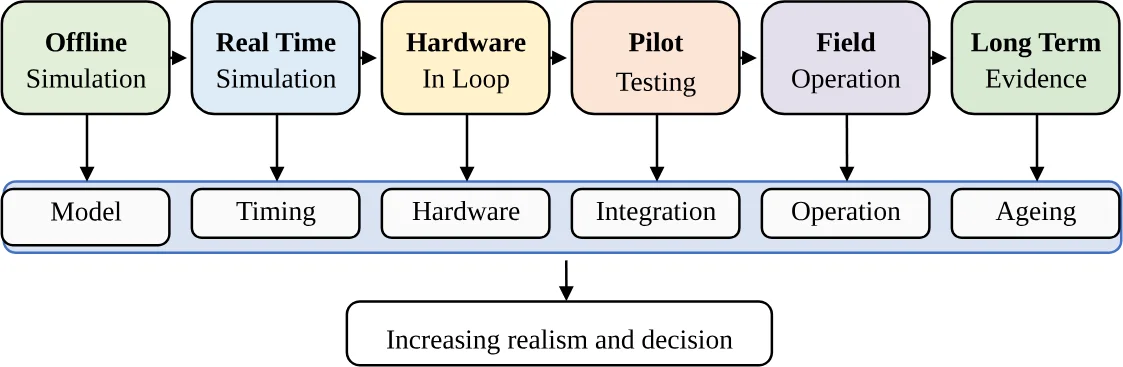
Also, the path warns against being too bold. A study with a simulation can be a valid comparative statement in the context of the conditions it models, but can't be used as evidence of readiness for deployment. On the other hand, a field study may discover true operating worthiness without the isolation of a laboratory test. Triangulation in stages is a good source of strong evidence. Validation maturity is a measure of confidence that an asset can be leveraged in the laboratory and will also do so in operation, but does not mean that an asset will continue to provide an advantage during times of extreme disturbance or throughout the technical, economic, and environmental life of the asset. The motivation for the lifecycle synthesis in Section 5 is those questions.
5. Power-System Resilience and Lifecycle Value
5.1 Resilience Requirements and Metrics
Resilience of a power system is evaluated based on the service provided during a given disturbance and the recovery process. The indicators for preparation, absorption, response, and recovery are complementary. Hazard, vulnerable assets, outage duration, resources available, and the baseline restoration policy are useful assessments to compare interventions [76] and [77]. Then, critical-load energy is interpreted in the context of unserved energy, recovery time, and the trajectory of the restored-service energy. The Expected energy not supplied (EENS) concept includes scenario probabilities; unserved energy for any one stress event is a conditional outcome of the stress event and is not an expectation without a probability model. Reliability can continue to be measured by conventional outage-frequency and duration metrics, but these are inadequate to capture the entire disturbance and recovery process.
The service objective is also important. A hospital microgrid might focus on continuous supply of critical loads while a distribution utility might focus on restored customer service or recovery time. Uncertainty in the demand and renewable resources over the project horizon must be taken into consideration when planning with climate information [42]. Avoided outage damage can be a part of an economic valuation, if the service loss counterfactual and valuation assumptions are made explicit [15]. Increased efficiency can contribute to resilience by saving precious energy, but it is not resilience if it is not tested during disruption, for example, in the case of communication or control failures where applicable.
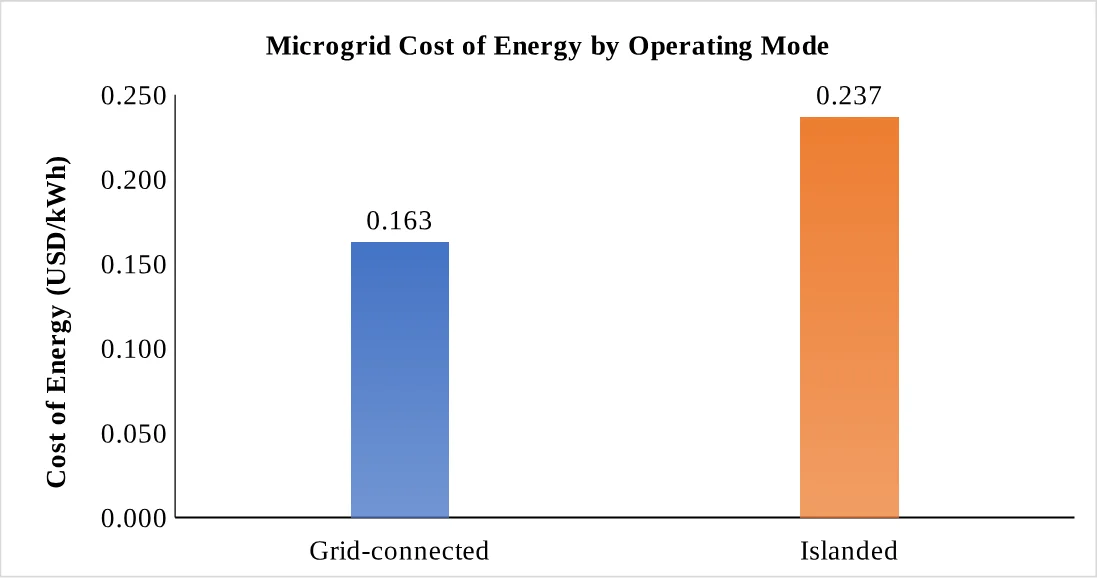
The cost of providing a service is different when operating in a different mode. The microgrid planning study for the cyclone-prone area indicates the cost of energy in the grid-connected mode of USD 0.163/kWh and in the islanded mode, USD 0.237/kWh [46]. This case-specific comparison is reproduced in Figure 4. These modelled costs are not a stand-alone islanding premium, nor are they a direct estimate of monetised resilience benefit, but rather a trade-off between the source assumptions. That benefit has to be separately compared to the losses in service during the event described.
5.2 Technical Lifecycle Value
Technical lifecycle value is related to the longevity of useful service of assets over time. The degradation-aware battery planning demonstrates the need to take both initial capacity and performance into account, along with the operating horizon [13]. Indicators that are relevant are efficiency retention, usable capacity, availability, maintenance needs, and useful life. When evaluating comparable resources, such as communication equipment and other grid assets for converters, the specific operating stress, failure, and maintenance assumptions need to be given. The changes to be measured, the changes to be inferred from accelerated testing, and the changes to be extrapolated from a model should be identified in a lifecycle claim.
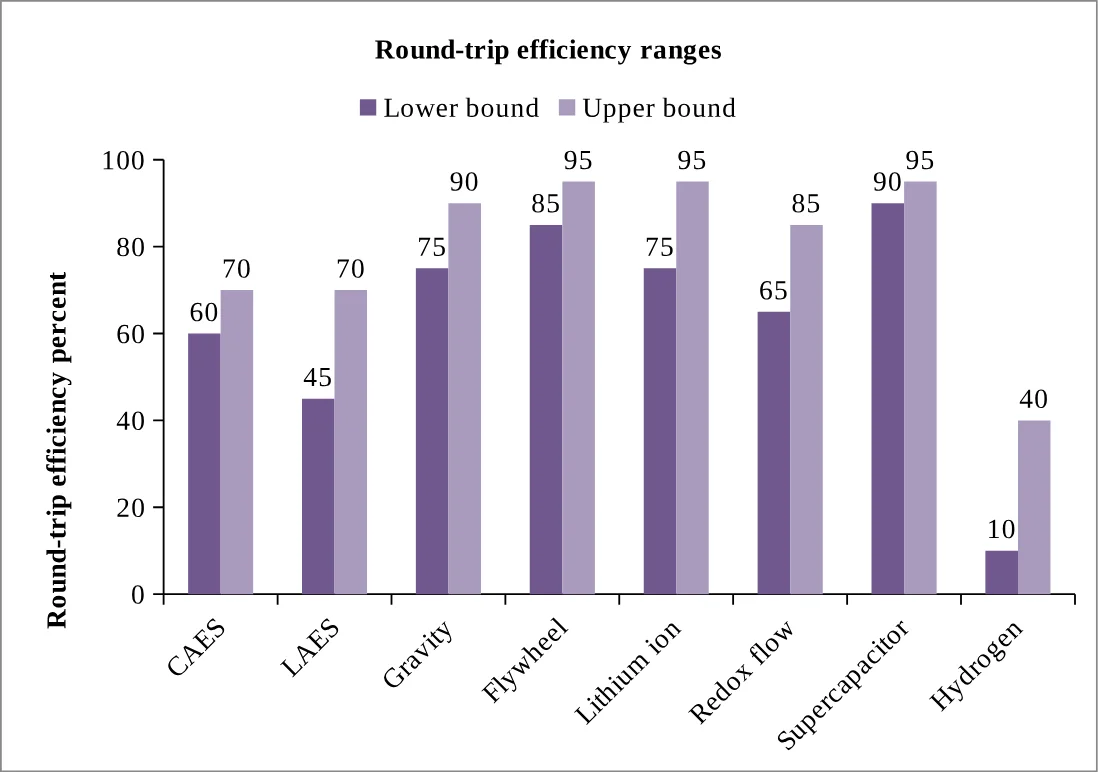
Stochastic Microgrid Operation links dispatch decisions with future Battery State [55]. This means that the condition of the battery at the time of its reuse is significant for the service that it will be used for. Residual-health assessment and an application that is appropriate for the remaining capability are required for second-life storage [50]. Technology Level round trip efficiency ranges from the storage literature are shown in Figure 5. These are reported ranges, not confidence intervals or results of a common test protocol [78]. They are not useful for ranking technologies because of operating conditions and energy boundaries differences, and they need additional duration, response, lifetime, and siting information to make service-specific comparisons.
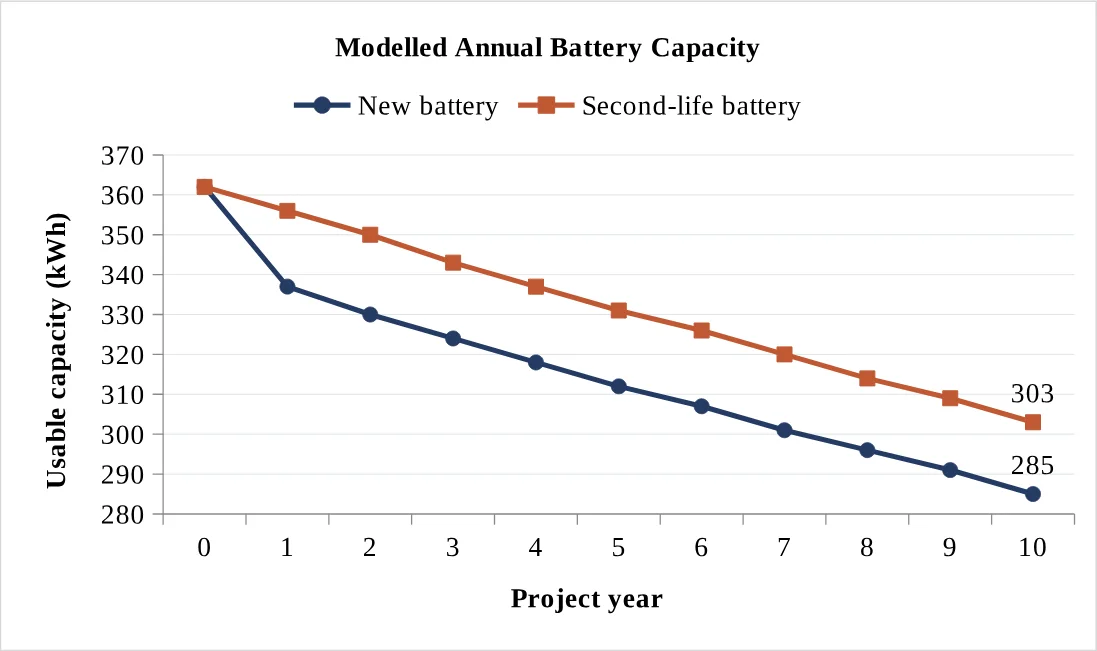
Equal starting capacity can mask different ageing trajectories. The annual model outputs shown in Figure 4(a) of Cao et al. [79] are again redrawn in Figure 6, but with the values digitized from the published vector plot and rounded to the nearest kWh. One year of operational data is used in their 10-year simulation. The initial charge capacity for both systems is 362 kWh, and after 10 years, the new battery has a capacity of ~285 kWh while the second-life battery has a capacity of ~303 kWh. The new-battery model exhibits a higher initial loss rate, but a lower loss rate later on, while the second-life model has a more uniform loss rate. Equal usable capacity doesn't necessarily mean equal rated capacity; the initial state of health is 100% and 80%, respectively. The case-specific projections are based on source assumptions and are not considered to be generally superior second-life durability.
5.3 Economic Lifecycle Value
Economic lifecycle value is a comparison of costs and benefits of providing a defined service over time. Capital expenditure (CAPEX), operating expenditure (OPEX), efficiency losses, maintenance, replacement, and residual value need to be considered consistently [11]. Net present value (NPV) is dependent on the discount rate and cash-flow assumptions, and the internal rate of return (IRR) is the discount rate at which NPV is equal to zero. Costs must be included explicitly in the levelized cost of storage (LCOS), and energy is required in the levelized cost of energy (LCOE). Other capital components such as acquisition should not be included in the operational LCOS, and should not be compared with a full lifecycle LCOS. The benefits of any combined valuation of arbitrage and other grid services should be preceded by a check whether the services can be provided in combination.
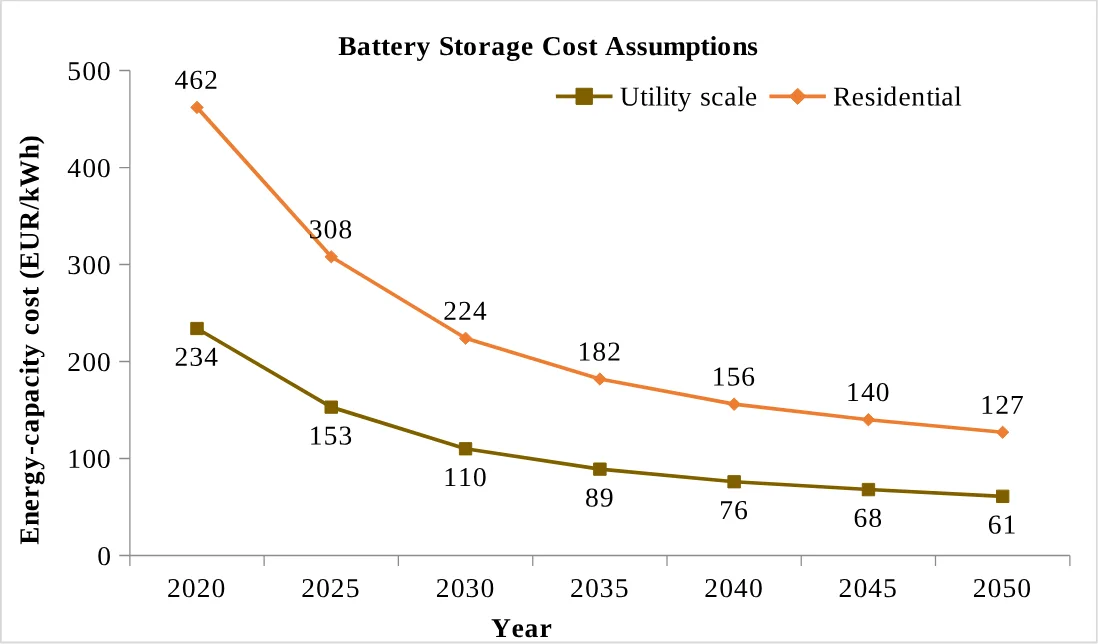
Avoiding outage damage and a quicker recovery can be a source of value of resilience. It is valued based on the hazard exposure and the loss of service in a counterfactual scenario [15]. These benefits should not be “double counted” in market revenues. There is also a need for a price year, location, discount rate, duty cycle, replacement policy, and sensitivity analysis for economic comparisons. The battery storage CAPEX assumptions shown in Table 5 of the African energy-transition model [80] are reproduced in Figure 7. It offers energy-capacity costs, in EUR/kWh, for its utility-scale and residential series, and battery interfaces are given separately in EUR/kW. The plotted values for the entries in the interface are therefore not the total value of the installed system, but rather exclude those entries for the interface. The numbers they project for the 2020-2050 drop are based on a scenario, not on an independent market forecast.
5.4 Environmental Lifecycle Value
Environmental lifecycle value takes into account the impacts beyond operational emissions. The stationary-battery conclusions rely on manufacturing, charging electricity, losses, utilization, replacement, and end-of-life treatment [14]. Electric-vehicle battery LCA may be used to offer context to the methodology, but will need boundary changes before moving to stationary storage. Material demand and manufacturing impacts–material demand and allocation of impacts are affected by recycling and reuse [51, 56]. The assessment boundary should be different for pumped-hydro storage. The importance of civil infrastructure, site, land and water conditions, and asset life starts to rise [57]. These differences make it impossible to provide an operational efficiency-based defensible ranking.
The functional unit should be the service of interest that is being compared, such as a unit of electricity delivered as a service with a specified availability and storage duration. There are different questions you are asking when you ask about results per unit of installed capacity vs results per unit of delivered energy. Allocation of the burdens incurred in manufacturing and the reuse of components, transport, residual life, and end-of-life credits shall be mentioned for second-life systems. Avoided-emission credits are also based on the displaced generation and counterfactual operation. There are embodied impacts of sensing, communication, computing and power electronics [9]. Environmental benefits should be compared with alternative mixes of electricity generation, with different life spans, replacement frequencies and allocations, not just by the re-use label.
5.5 Operational and Deployment Value (OPDV)
The operational value is whether the service that is proposed can be delivered, maintained and updated in an existing power system. Experience from the industry indicates that issues of interoperability, security and integration are deployment concerns [2]. Assumptions and interfaces, protection coordination, failure and fallback behaviour, requirements for commissioning, operator workload, and maintenance resources should therefore be reported in the evaluation. The factors of realism in the laboratory and the cost and continuity of real services are linked.
Changes in equipment, demand, and data distributions are also introduced when deploying for data-driven control and digital twins. In digital-twin frameworks, the importance of having a credible relationship between the physical system and its model has been stressed [71]. Evaluation should document changes to the model, re-training, access restrictions, and software versions, so that changes in operations and not changes in algorithms are identified. Pilot and field records should contain information about availability, how often the intervention is used, information on when it has been updated, and how it performs following changes. This evidence can be used in conjunction with technical efficiency in lifetime comparisons.
5.6 Linking Efficiency, Resilience, and Lifecycle Value
The reason that efficiency is an input to lifecycle assessment, and not an output, is the reason mentioned above. An efficiency advantage can be lost through premature replacement and/or expensive integration. An operating policy that is resilient can reduce the normal operation cost, but may increase critical service cost, and the environment can change as a function of material production, replacement, recycling, and displacement credits. The motivation for this approach, which is explored in Sections 5.1-5.5, is that it is best to start with a well-defined grid service and operating envelope and evaluate the trade-offs within a common boundary.
Complementary measures and evidence need are identified in Table 4. These dimensions should not be combined into an overall score without proper weights, stakeholder preferences, and without the risk of double counting. There are four components to feasibility: technical and operational, resilience, economics, and environmental assessment. A result can have both positive and negative aspects. It's better to report the trade-off than to say a general improvement in technology from one measure.
The following are illustrative examples of these compromises in a commercial building battery model. When looking at the second-life case, approximately 49.2% more NPV, 41.2% more IRR, 13.7% less operational LCOS, and 41.7% less battery embodied emissions can be seen when recalculating from its displayed tables. The IRR is increasing by 4.2 percentage points from 10.2% to 14.4%. Reported net carbon intensity change ranges from −0.23 kg CO₂e/kWh to −0.25 kg CO₂e/kWh, which is 8.7% less than the baseline. With one calculation rule, as in Figure 8, the comparisons take place.
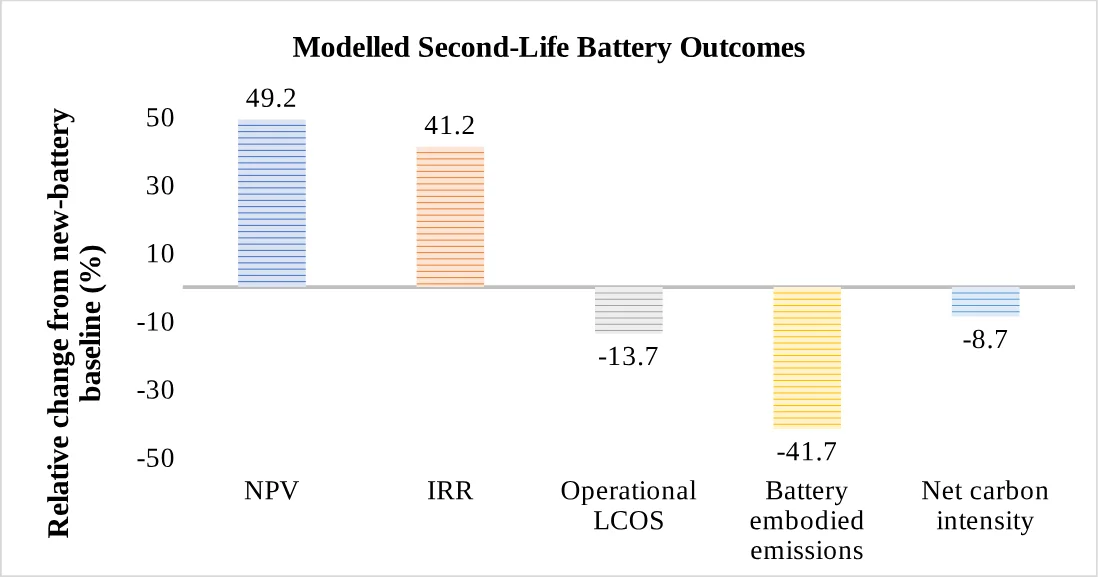
The financial and environmental outcomes are based on the battery model in Figure 6 and are not standalone evidence of the long-term performance of the model. They are transferred based on the assumed tariff, dispatch, acquisition cost, degradation model, usable capacity, rated capacity, and carbon accounting. Negative net carbon intensity is not an indication of battery carbon removal, but simply credits and reflects the boundary of the source. The example can be used to consider a couple of dimensions together, and Table 4 provides the general evidence required for making a lifecycle-value claim.
Table 4. Lifecycle-value metrics
| Dimension | Core metrics | Evidence needed | Relevant timescale |
|---|---|---|---|
| Technical | Efficiency retention; usable capacity; degradation; availability; useful life | Ageing models or tests with stated conditions; validation against observations | Seconds to asset life |
| Resilience | Critical load served; event unserved energy; recovery time; restoration trajectory | Defined hazard and counterfactual; stress tests and relevant operational evidence | Event and recovery |
| Economic | CAPEX; OPEX; replacement; NPV; LCOS or LCOE | Price year, discount rate, service, energy denominator, and cost boundary | Years to asset life |
| Environmental | Embodied impacts; use-phase losses; resource demand; end-of-life impacts | LCA functional unit, boundary, electricity mix, allocation, and credits | Full lifecycle |
| Operational and deployment | Availability; maintainability; interoperability; intervention and integration effort | Pilot or field records, interface tests, maintenance and update histories | Months to years |
6. Reproducibility gaps and Research Roadmap
6.1 Reproducibility Requirements and Evidence Limits
The 10 criteria convert the reproducibility principles discussed in Sections 1 and 2.6 into specific reporting questions. Data provenance and access define what can be reconstructed; model and parameter disclosure define the experiment; software and code versions identify the implementation; baselines, uncertainty treatment, validation procedures, and lifecycle assumptions determine how results can be checked. Criteria used here as an Interpretive Framework. This review does not offer an audited study-level compliance matrix, and is therefore not able to provide any estimation of the number of publications that fulfill any criterion or rank the technologies by their reproducibility.
What would be helpful for a future audit is to have a location of the source and a decision on applicability for each criterion. A lack of reporting doesn't necessarily mean a lack of good practice. Access statement required for restricted utilities data or proprietary test systems; synthetic distribution systems can be one way to a shareable test case [62]. If possible, a procedure for the reconstruction should accompany the report that can be executed. Independent reruns should inform of tolerances, software requirements, and disagreements, as disclosure is not proof of a result having been reproduced. A versioned evidence matrix and coding checks of the document would be required prior to presenting criterion frequencies, or cross-analyses of validation and lifecycle coverage.
6.2 Key Research Gaps
From the thematic synthesis, there are three related evidence needs. First, transferability has to be demonstrated, and it must be shown that there is a traceable link between the conditions tested and the proposed deployment, and the effects on the hardware and the time of the deployment. Second, the boundaries of the service and life cycle must be consistent in all four types of value analysis: degradation, economic, resilience, and environmental. Third, the assumptions, conditions of data access, and baseline conditions need to be clear for independent checking, and conditions of learning and transfer are required for learning-based control. These priorities link the evidence for validation in Section 4 and the assessment for the lifecycle in Section 5. They are not a quantitative measure of the distribution of weaknesses among all of the cited literature on the smart grid, but rather are conclusions drawn from the cited literature.
The needs are interrelated. The incompleteness of a model makes it hard to compare with hardware testing, the unvalidated degradation projection leads to uncertainty in replacement cost and embodied emissions, and the uncertainty of a resilience policy evaluated using a different service boundary cannot be directly added to the uncertainty of normal operation revenues. In the numerical examples in Section 5, these differences are made real, but are limited in number and limited in scope to make the judgements of prevalence technology-wide. Study-level evidence mapping that would be documented prospectively would be the next step in the synthesis, followed by a review, primary experiments, model projections, and repeated reporting of the same case.
6.3 Proposed Laboratory-to-Lifecycle Framework
The four evidence questions in the proposed lab-to-lifecycle framework are connected to the four lenses of the lifecycle-value shown in Figure 9. Performance is asking if the innovation is fulfilling the service requirement with respect to an appropriate baseline. Reproducibility is related to the ability of its assumptions and implementation to be rebuilt. Validation asks if the claim remains valid in the face of data changes, changes in time, hardware, or scale, or changes in operating conditions. Resilience considers if the service is available or can be restored under a stated disturbance. These questions are revisited in the making of the application, but are not a sequential list of questions nor a ranking of research quality.
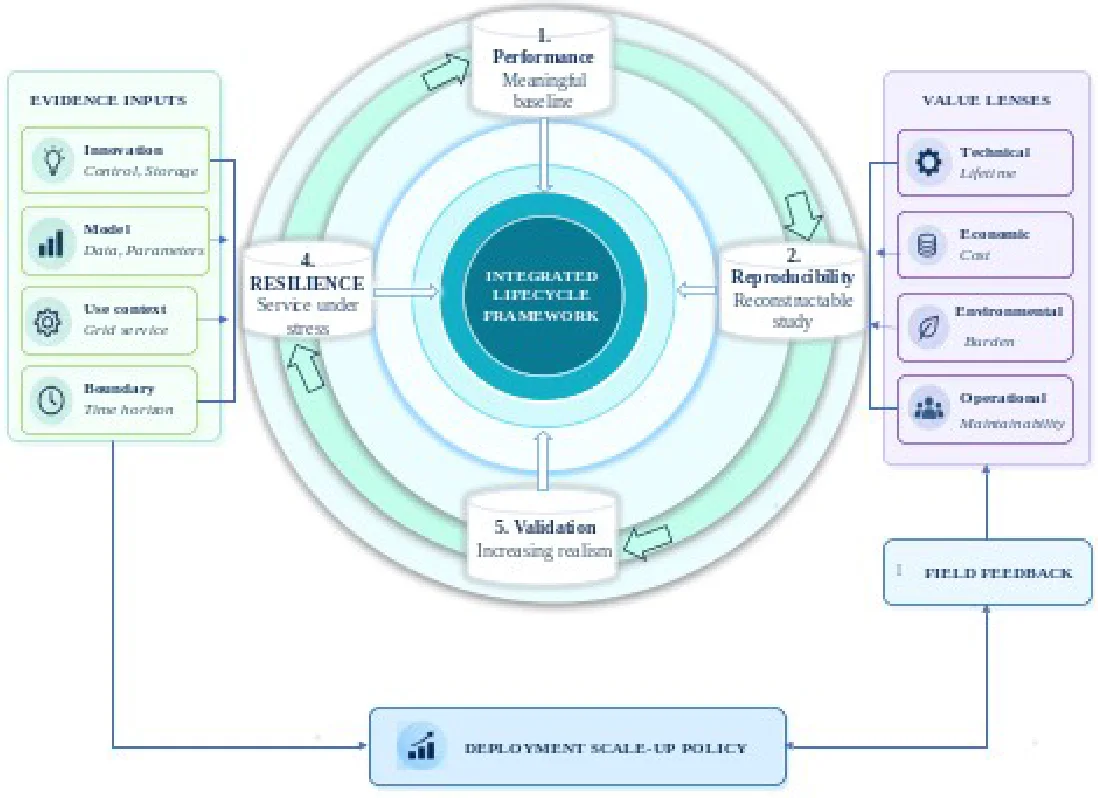
The value lenses for deployment then are technical durability, economic performance, environmental burden, and operational maintainability. The claim-to-evidence record would be a practical application that would keep a record of the service objective, baseline, operating boundary, artifacts of reproducibility, validation evidence, and unresolved uncertainty. Before evaluation, the application should be evaluated using a set of limits (acceptance limits) that have been established for the application, rather than being assumed from a positive evaluation. Field feedback revises the assumptions and test scenarios, and disagreement with a model leads to re-evaluation. The framework is presented as a decision aid; the usefulness and thresholds presented here have not been validated by third parties, and exploratory studies are not necessarily required to go to the point of a field deployment to contribute well-bounded results.
6.4 Reproducible Research Roadmap
The roadmap is based on near-, mid-, and long term time horizons as milestones and not a calendar forecast. Near-term work sets a baseline that is reconstructable: the test network, data provenance and access, a complete set of parameters, a version of the software environment, baseline methods, uncertainty analysis. The deliverable is an executable or adequate evidence package and record of an independent reconstruction attempt (as appropriate). These requirements are not completed in one go and forgotten about, but are carried on to the next stages of reporting, in accordance with Section 6.1 reporting criteria.
Medium-term work is conducted to determine if the promising results continue to hold true under implementation constraints via real-time simulation (either CHIL or PHIL as appropriate to the claim), and pilot operation. The duty cycle, service requirement, and equipment assumptions should be the same for matching lifecycle scenarios for economic and environmental analysis. Long-term work captures long-term degradation, failures, maintenance, replacements, and service delivery. Digital twins can help with updating the model with synchronization and prediction errors, and asset-condition records facilitate reusing and recycling. This progression is summarized in Figure 10 and is detailed in Table 5 for evidence deliverables.
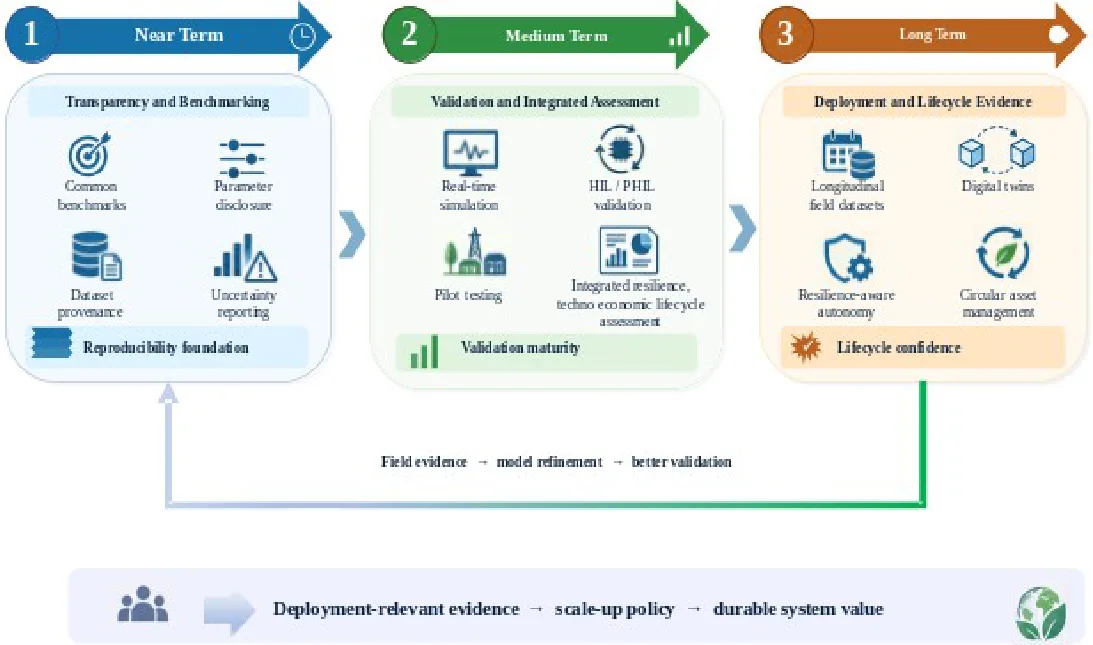
When implementing, responsibilities for individual evidence packages should be assigned. Research teams document models and comparisons; laboratories characterize interfaces and test limitations; utilities and pilot operators record integration and service performance; and asset owners maintain longitudinal histories. A claim without a short demonstration is not enough: the lifetime economics and degradation remain unaddressed. The evidence required to support the proposed claim is the basis for advancement, not the project period.
Table 5. Proposed research priorities, evidence deliverables, and milestone horizons
| Evidence need | Decision relevance | Required deliverable | Validation target | Horizon |
|---|---|---|---|---|
| Transferability | Controlled gains may change during implementation | Matched baseline and scenario package; documented timing and interface tests | Relevant HIL and pilot tests | Near–medium |
| Reconstruction | Independent comparison requires identifiable inputs | Versioned data/model package; parameter and access records; reconstruction report | Applicable at every stage | Near onward |
| Durability | Ageing and maintenance affect lifetime benefit | Calibrated degradation assumptions; failure, maintenance, and replacement histories | Ageing tests and longitudinal observations | Medium–long |
| Resilient service | Normal-operation metrics do not describe disruption | Hazard and outage definition; critical-load and recovery evidence | Stress tests and relevant pilot/field events | Medium onward |
| Integrated value | Benefits can shift costs or impacts across boundaries | Consistent service, lifecycle costing, LCA, and operational assessment with sensitivity analysis | Comparable scenario and field-informed assessments | Medium–long |
6.5 Implications and Limitations
It provides a structure that enables researchers to conclude only when the test conditions are similar to operational conditions, to help utilities differentiate model projections from operational evidence, and allows manufacturers to include durability and integration requirements in addition to initial efficiency. Its conclusions are limited by a non-exhaustive set of journal references in English, citing publication years 2020-2025, and do not have a screening log for the reconstructable database. Selection and publication bias will not be quantified. There are different types of primary studies and reviews, and when multiple sources are the same, they do not replicate. There are no reported prevalence estimates for study-level quality and/or reproducibility. The storage examples are used to show the argument, but are not a complete picture of the technology diversity of smart grids. The uncertainty in the extraction process and rounding in the data points are carried forward to the digitized points, and the precision and boundaries of the data points are carried forward to the calculated percentages. The proposed framework hasn't been used as a predictive deployment tool. Generalizability needs to be assessed with a systematic evidence map and independently by applications of the framework.
7. Conclusions
The structured critical review links the performance of the smart grid, its validation, its resilience, its reproducibility, and the value of its life cycle via a common claim-to-evidence framework. It does not seek to provide an average performance or a counted number of reporting practices, but rather this contribution is the inclusion of such evaluation requirements and the translation of these requirements into a research roadmap. While technical metrics are still required, these need to be interpreted based on the objective of the service, the baseline, the operating conditions, and the observation horizon.
Validation and lifetime duration need to be separated. There is a balance between controlled exploration via simulation, real-time and HIL testing, and integration and operational context via pilot testing and field studies. A multi-year simulation that is based on measurements is a projection until it can be verified with measurements that the outputs from the simulation are relevant to the measurements. Similarly, for resilience to be demonstrated, it is important that there is evidence of service during a specified disruption, not just an inference from normal-operation efficiency.
The case examples demonstrate the need for cost, degradation, environment, and operational considerations to go hand-in-hand with efficiency comparisons. They also make it clear that ranges of technologies are not “matched” experiments, cost assumptions for scenarios are not market predictions, and relative changes must be based on the same baseline and units. They serve as an incentive for wider assessment, but do not set a standard for the preferred storage technology.
The roadmap focuses on packages of research that can be reconstructed, validation with implementation considerations, and evidence from operation over a longer term. Progress should be measured as to whether or not the desired claim can be validated and ported to the claim's intended use case. Efficiency is a strong enabler of technical viability; Reproducibility is a strong enabler of credibility; Validation is a strong enabler of transferability; Resilience and lifecycle assessment are strong enablers of a defensible account of enduring system value. The framework is still a proposal that needs applications that have been documented and independent comparisons to confirm the practicability of its application.
References
- [1] C. P. Ohanu, S. A. Rufai, and U. C. Oluchi, “A comprehensive review of recent developments in smart grid through renewable energy resources integration,” Heliyon, vol. 10, no. 3, Art. no. e25705, 2024, doi: 10.1016/j.heliyon.2024.e25705.
- [2] J. Powell, A. McCafferty-Leroux, W. Hilal, and S. A. Gadsden, “Smart grids: A comprehensive survey of challenges, industry applications, and future trends,” Energy Rep., vol. 11, pp. 5760–5785, 2024, doi: 10.1016/j.egyr.2024.05.051.
- [3] C. Barrera-Singaña, M. P. Comech, and H. Arcos, “A Comprehensive Review on the Integration of Renewable Energy Through Advanced Planning and Optimization Techniques,” Energies, vol. 18, no. 11, Art. no. 2961, 2025, doi: 10.3390/en18112961.
- [4] R. I. Areola, A. A. Adebiyi, and K. Moloi, “Integrated Energy Storage Systems for Enhanced Grid Efficiency: A Comprehensive Review of Technologies and Applications,” Energies, vol. 18, no. 7, Art. no. 1848, 2025, doi: 10.3390/en18071848.
- [5] S. Asiaban et al., “Wind and Solar Intermittency and the Associated Integration Challenges: A Comprehensive Review Including the Status in the Belgian Power System,” Energies, vol. 14, no. 9, Art. no. 2630, 2021, doi: 10.3390/en14092630.
- [6] H. Pishbahar, F. Blaabjerg, and H. Saboori, “Emerging grid-forming power converters for renewable energy and storage resources integration – A review,” Sustain. Energy Technol. Assess., vol. 60, Art. no. 103538, 2023, doi: 10.1016/j.seta.2023.103538.
- [7] H. Yu, S. Niu, Y. Shang, Z. Shao, Y. Jia, and L. Jian, “Electric vehicles integration and vehicle-to-grid operation in active distribution grids: A comprehensive review on power architectures, grid connection standards and typical applications,” Renew. Sustain. Energy Rev., vol. 168, Art. no. 112812, 2022, doi: 10.1016/j.rser.2022.112812.
- [8] L. Sun, J. Teh, W. Liu, C.-M. Lai, and L.-R. Chen, “Impact of electric vehicles on power system reliability and related improvements: A review,” Electr. Power Syst. Res., vol. 247, Art. no. 111838, 2025, doi: 10.1016/j.epsr.2025.111838.
- [9] B. Durillon and A. Bossu, “Environmental assessment of smart energy management systems at distribution level — A review,” Renew. Sustain. Energy Rev., vol. 203, Art. no. 114739, 2024, doi: 10.1016/j.rser.2024.114739.
- [10] J. Montoya et al., “Advanced Laboratory Testing Methods Using Real-Time Simulation and Hardware-in-the-Loop Techniques: A Survey of Smart Grid International Research Facility Network Activities,” Energies, vol. 13, no. 12, Art. no. 3267, 2020, doi: 10.3390/en13123267.
- [11] A. Emrani and A. Berrada, “A comprehensive review on techno-economic assessment of hybrid energy storage systems integrated with renewable energy,” J. Energy Storage, vol. 84, Art. no. 111010, 2024, doi: 10.1016/j.est.2024.111010.
- [12] S. Aslam, H. Herodotou, S. M. Mohsin, N. Javaid, N. Ashraf, and S. Aslam, “A survey on deep learning methods for power load and renewable energy forecasting in smart microgrids,” Renew. Sustain. Energy Rev., vol. 144, Art. no. 110992, 2021, doi: 10.1016/j.rser.2021.110992.
- [13] R. Fallahifar and M. Kalantar, “Optimal planning of lithium ion battery energy storage for microgrid applications: Considering capacity degradation,” J. Energy Storage, vol. 57, Art. no. 106103, 2023, doi: 10.1016/j.est.2022.106103.
- [14] M. A. Pellow, H. Ambrose, D. Mulvaney, R. Betita, and S. Shaw, “Research gaps in environmental life cycle assessments of lithium ion batteries for grid-scale stationary energy storage systems: End-of-life options and other issues,” Sustain. Mater. Technol., vol. 23, Art. no. e00120, 2020, doi: 10.1016/j.susmat.2019.e00120.
- [15] K. Anderson et al., “Integrating the Value of Electricity Resilience in Energy Planning and Operations Decisions,” IEEE Syst. J., vol. 15, no. 1, pp. 204–214, 2021, doi: 10.1109/jsyst.2019.2961298.
- [16] C. L. Henry et al., “Promoting reproducibility and increased collaboration in electric sector capacity expansion models with community benchmarking and intercomparison efforts,” Appl. Energy, vol. 304, Art. no. 117745, 2021, doi: 10.1016/j.apenergy.2021.117745.
- [17] V. J. Schwanitz et al., “Current state and call for action to accomplish findability, accessibility, interoperability, and reusability of low carbon energy data,” Sci. Rep., vol. 12, no. 1, Art. no. 5208, 2022, doi: 10.1038/s41598-022-08774-0.
- [18] S. Berendes et al., “Evaluating the usability of open source frameworks in energy system modelling,” Renew. Sustain. Energy Rev., vol. 159, Art. no. 112174, 2022, doi: 10.1016/j.rser.2022.112174.
- [19] S. Pfenninger, “Open code and data are not enough: understandability as design goal for energy system models,” Prog. Energy, vol. 6, no. 3, Art. no. 033002, 2024, doi: 10.1088/2516-1083/ad371e.
- [20] A. Younesi, H. Shayeghi, Z. Wang, P. Siano, A. Mehrizi-Sani, and A. Safari, “Trends in modern power systems resilience: State-of-the-art review,” Renew. Sustain. Energy Rev., vol. 162, Art. no. 112397, 2022, doi: 10.1016/j.rser.2022.112397.
- [21] M. Khalid, “Smart grids and renewable energy systems: Perspectives and grid integration challenges,” Energy Strategy Rev., vol. 51, Art. no. 101299, 2024, doi: 10.1016/j.esr.2024.101299.
- [22] M. Y. Worku, “Recent Advances in Energy Storage Systems for Renewable Source Grid Integration: A Comprehensive Review,” Sustainability, vol. 14, no. 10, Art. no. 5985, 2022, doi: 10.3390/su14105985.
- [23] M. S. Bakare, A. Abdulkarim, M. Zeeshan, and A. N. Shuaibu, “A comprehensive overview on demand side energy management towards smart grids: challenges, solutions, and future direction,” Energy Inform., vol. 6, no. 1, Art. no. 4, 2023, doi: 10.1186/s42162-023-00262-7.
- [24] M. Cavus, “Advancing Power Systems with Renewable Energy and Intelligent Technologies: A Comprehensive Review on Grid Transformation and Integration,” Electronics, vol. 14, no. 6, Art. no. 1159, 2025, doi: 10.3390/electronics14061159.
- [25] T. Kataray et al., “Integration of smart grid with renewable energy sources: Opportunities and challenges – A comprehensive review,” Sustain. Energy Technol. Assess., vol. 58, Art. no. 103363, 2023, doi: 10.1016/j.seta.2023.103363.
- [26] M. S. Alam et al., “Renewable energy integration with DC microgrids: Challenges and opportunities,” Electr. Power Syst. Res., vol. 234, Art. no. 110548, 2024, doi: 10.1016/j.epsr.2024.110548.
- [27] H. Asadi Aghajari et al., “Analyzing complexities of integrating Renewable Energy Sources into Smart Grid: A comprehensive review,” Appl. Energy, vol. 383, Art. no. 125317, 2025, doi: 10.1016/j.apenergy.2025.125317.
- [28] H. Gharibvand, G. B. Gharehpetian, and A. Anvari-Moghaddam, “A survey on microgrid flexibility resources, evaluation metrics and energy storage effects,” Renew. Sustain. Energy Rev., vol. 201, Art. no. 114632, 2024, doi: 10.1016/j.rser.2024.114632.
- [29] K. Akhila, A. S. Pillai, K. Priya R, and A. Al-Shahri, “Towards Resilient Energy Infrastructures: A Comprehensive Review on the Role of Demand Response in Smart Grids,” Sustain. Energy Technol. Assess., vol. 74, Art. no. 104170, 2025, doi: 10.1016/j.seta.2025.104170.
- [30] O. J. Guerra, J. Zhang, J. Eichman, P. Denholm, J. Kurtz, and B.-M. Hodge, “The value of seasonal energy storage technologies for the integration of wind and solar power,” Energy Environ. Sci., vol. 13, no. 7, pp. 1909–1922, 2020, doi: 10.1039/d0ee00771d.
- [31] J. J. Plotnek and J. Slay, “Power systems resilience: Definition and taxonomy with a view towards metrics,” Int. J. Crit. Infrastruct. Prot., vol. 33, Art. no. 100411, 2021, doi: 10.1016/j.ijcip.2021.100411.
- [32] C. Wang, P. Ju, F. Wu, X. Pan, and Z. Wang, “A systematic review on power system resilience from the perspective of generation, network, and load,” Renew. Sustain. Energy Rev., vol. 167, Art. no. 112567, 2022, doi: 10.1016/j.rser.2022.112567.
- [33] S. W. Monie, M. Gustafsson, S. Önnered, and K. Guruvita, “Renewable and integrated energy system resilience – A review and generic resilience index,” Renew. Sustain. Energy Rev., vol. 215, Art. no. 115554, 2025, doi: 10.1016/j.rser.2025.115554.
- [34] T. Rahman, M. S. Hossain Lipu, M. M. Alom Shovon, I. Alsaduni, T. F. Karim, and S. Ansari, “Unveiling the impacts of climate change on the resilience of renewable energy and power systems: Factors, technological advancements, policies, challenges, and solutions,” J. Clean. Prod., vol. 493, Art. no. 144933, 2025, doi: 10.1016/j.jclepro.2025.144933.
- [35] A. T. D. Perera, V. M. Nik, D. Chen, J.-L. Scartezzini, and T. Hong, “Quantifying the impacts of climate change and extreme climate events on energy systems,” Nature Energy, vol. 5, no. 2, pp. 150–159, 2020, doi: 10.1038/s41560-020-0558-0.
- [36] A. K. Erenoğlu, I. Sengor, and O. Erdinç, “Power System Resiliency: A Comprehensive Overview from Implementation Aspects and Innovative Concepts,” Energy Nexus, vol. 15, Art. no. 100311, 2024, doi: 10.1016/j.nexus.2024.100311.
- [37] Y. Wang, A. O. Rousis, and G. Strbac, “On microgrids and resilience: A comprehensive review on modeling and operational strategies,” Renew. Sustain. Energy Rev., vol. 134, Art. no. 110313, 2020, doi: 10.1016/j.rser.2020.110313.
- [38] T. E. K. Zidane et al., “Power systems and microgrids resilience enhancement strategies: A review,” Renew. Sustain. Energy Rev., vol. 207, Art. no. 114953, 2025, doi: 10.1016/j.rser.2024.114953.
- [39] S. Mishra, K. Anderson, B. Miller, K. Boyer, and A. Warren, “Microgrid resilience: A holistic approach for assessing threats, identifying vulnerabilities, and designing corresponding mitigation strategies,” Appl. Energy, vol. 264, Art. no. 114726, 2020, doi: 10.1016/j.apenergy.2020.114726.
- [40] R. Wu and G. Sansavini, “Integrating reliability and resilience to support the transition from passive distribution grids to islanding microgrids,” Appl. Energy, vol. 272, Art. no. 115254, 2020, doi: 10.1016/j.apenergy.2020.115254.
- [41] J. Tobajas, F. Garcia-Torres, P. Roncero-Sánchez, J. Vázquez, L. Bellatreche, and E. Nieto, “Resilience-oriented schedule of microgrids with hybrid energy storage system using model predictive control,” Appl. Energy, vol. 306, Art. no. 118092, 2022, doi: 10.1016/j.apenergy.2021.118092.
- [42] M. Macmillan, A. Zolan, M. Bazilian, and D. L. Villa, “Microgrid design and multi-year dispatch optimization under climate-informed load and renewable resource uncertainty,” Appl. Energy, vol. 368, Art. no. 123355, 2024, doi: 10.1016/j.apenergy.2024.123355.
- [43] Z. Xu, Y. Chen, L. Sang, H. Qiu, Z. Wu, and H. Ye, “Resilience-oriented planning for microgrid clusters considering P2P energy trading and extreme events,” Appl. Energy, vol. 388, Art. no. 125560, 2025, doi: 10.1016/j.apenergy.2025.125560.
- [44] S. Badakhshan, R. A. Jacob, B. Li, P. Wang, and J. Zhang, “Self-healing power systems using reinforcement learning over graphs for controlled grid islanding,” Sustain. Energy Grids Netw., vol. 44, Art. no. 101937, 2025, doi: 10.1016/j.segan.2025.101937.
- [45] J. Wang, M. Li, D. Yin, and J. Ouyang, “Fault recovery strategy of distribution network considering active participation of photovoltaic-storage-charging integrated station under extreme weather disasters,” Sustain. Energy Grids Netw., vol. 40, Art. no. 101586, 2024, doi: 10.1016/j.segan.2024.101586.
- [46] M. H. N. Amiri, S. Dhundhara, F. Annaz, M. De Oliveira, and F. Gueniat, “Two-stage microgrid resilience and battery life-aware planning and operation for cyclone prone areas in India,” Sustain. Cities Soc., vol. 124, Art. no. 106290, 2025, doi: 10.1016/j.scs.2025.106290.
- [47] A. von Jouanne, E. Agamloh, and A. Yokochi, “Power Hardware-in-the-Loop (PHIL): A Review to Advance Smart Inverter-Based Grid-Edge Solutions,” Energies, vol. 16, no. 2, Art. no. 916, 2023, doi: 10.3390/en16020916.
- [48] S. Nigam, O. Ajala, A. D. Domínguez-García, and P. W. Sauer, “Controller hardware in the loop testing of microgrid secondary frequency control schemes,” Electr. Power Syst. Res., vol. 190, Art. no. 106757, 2021, doi: 10.1016/j.epsr.2020.106757.
- [49] A. Singhal et al., “Integrated life cycle assessment and techno-economic analysis of grid-scale energy storage alternatives for India,” Sustain. Prod. Consum., vol. 54, pp. 404–422, 2025, doi: 10.1016/j.spc.2025.01.011.
- [50] M. F. Roslan, P. R. Satpathy, T. Prasankumar, V. K. Ramachandaramurthy, M. Mansor, and S. L. Walker, “Second-life battery energy storage system for energy sustainability: Recent advancements, key takeaways and future perspectives,” J. Energy Storage, vol. 123, Art. no. 116808, 2025, doi: 10.1016/j.est.2025.116808.
- [51] M. Rezaei et al., “A review of lithium-ion battery recycling for enabling a circular economy,” J. Power Sources, vol. 630, Art. no. 236157, 2025, doi: 10.1016/j.jpowsour.2024.236157.
- [52] A. Bhatt, W. Ongsakul, and N. Madhu M., “Optimal techno-economic feasibility study of net-zero carbon emission microgrid integrating second-life battery energy storage system,” Energy Convers. Manag., vol. 266, Art. no. 115825, 2022, doi: 10.1016/j.enconman.2022.115825.
- [53] N. Q. Minh, N. D. Linh, and N. T. Khiem, “A mixed-integer linear programming model for microgrid optimal scheduling considering BESS degradation and RES uncertainty,” J. Energy Storage, vol. 104, Art. no. 114663, 2024, doi: 10.1016/j.est.2024.114663.
- [54] V. Safavi, A. M. Vaniar, N. Bazmohammadi, J. C. Vasquez, O. Keysan, and J. M. Guerrero, “A battery degradation-aware energy management system for agricultural microgrids,” J. Energy Storage, vol. 108, Art. no. 115059, 2025, doi: 10.1016/j.est.2024.115059.
- [55] P. Aaslid, M. Korpås, M. M. Belsnes, and O. B. Fosso, “Stochastic operation of energy constrained microgrids considering battery degradation,” Electr. Power Syst. Res., vol. 212, Art. no. 108462, 2022, doi: 10.1016/j.epsr.2022.108462.
- [56] A. Picatoste, D. Justel, and J. M. F. Mendoza, “Circularity and life cycle environmental impact assessment of batteries for electric vehicles: Industrial challenges, best practices and research guidelines,” Renew. Sustain. Energy Rev., vol. 169, Art. no. 112941, 2022, doi: 10.1016/j.rser.2022.112941.
- [57] Y. Du et al., “Life cycle assessment of the pumped hydro energy storage system in China,” Energy, vol. 331, Art. no. 137102, 2025, doi: 10.1016/j.energy.2025.137102.
- [58] H. A. Behabtu et al., “A Review of Energy Storage Technologies’ Application Potentials in Renewable Energy Sources Grid Integration,” Sustainability, vol. 12, no. 24, Art. no. 10511, 2020, doi: 10.3390/su122410511.
- [59] I. E. Atawi, A. Q. Al-Shetwi, A. M. Magableh, and O. H. Albalawi, “Recent Advances in Hybrid Energy Storage System Integrated Renewable Power Generation: Configuration, Control, Applications, and Future Directions,” Batteries, vol. 9, no. 1, Art. no. 29, 2023, doi: 10.3390/batteries9010029.
- [60] C. Wu, X.-P. Zhang, and M. Sterling, “Solar power generation intermittency and aggregation,” Sci. Rep., vol. 12, no. 1, Art. no. 1363, 2022, doi: 10.1038/s41598-022-05247-2.
- [61] D. Yang, Y. Lv, M. Ji, and F. Zhao, “Evaluation and economic analysis of battery energy storage in smart grids with wind–photovoltaic,” Int. J. Low-Carbon Technol., vol. 19, pp. 18–23, 2024, doi: 10.1093/ijlct/ctad142.
- [62] B. Palmintier et al., “Experiences developing large-scale synthetic U.S.-style distribution test systems,” Electr. Power Syst. Res., vol. 190, Art. no. 106665, 2021, doi: 10.1016/j.epsr.2020.106665.
- [63] A. Venzke, D. K. Molzahn, and S. Chatzivasileiadis, “Efficient creation of datasets for data-driven power system applications,” Electr. Power Syst. Res., vol. 190, Art. no. 106614, 2021, doi: 10.1016/j.epsr.2020.106614.
- [64] R. Machlev, A. Chachkes, J. Belikov, Y. Beck, and Y. Levron, “Open source dataset generator for power quality disturbances with deep-learning reference classifiers,” Electr. Power Syst. Res., vol. 195, Art. no. 107152, 2021, doi: 10.1016/j.epsr.2021.107152.
- [65] K. M. Tan, T. S. Babu, V. K. Ramachandaramurthy, P. Kasinathan, S. G. Solanki, and S. K. Raveendran, “Empowering smart grid: A comprehensive review of energy storage technology and application with renewable energy integration,” J. Energy Storage, vol. 39, Art. no. 102591, 2021, doi: 10.1016/j.est.2021.102591.
- [66] B. Biswal, S. Deb, S. Datta, T. S. Ustun, and U. Cali, “Review on smart grid load forecasting for smart energy management using machine learning and deep learning techniques,” Energy Rep., vol. 12, pp. 3654–3670, 2024, doi: 10.1016/j.egyr.2024.09.056.
- [67] R. Wazirali, E. Yaghoubi, M. S. S. Abujazar, R. Ahmad, and A. H. Vakili, “State-of-the-art review on energy and load forecasting in microgrids using artificial neural networks, machine learning, and deep learning techniques,” Electr. Power Syst. Res., vol. 225, Art. no. 109792, 2023, doi: 10.1016/j.epsr.2023.109792.
- [68] M. A. Judge, V. Franzitta, D. Curto, A. Guercio, G. Cirrincione, and H. A. Khattak, “A comprehensive review of artificial intelligence approaches for smart grid integration and optimization,” Energy Convers. Manag. X, vol. 24, Art. no. 100724, 2024, doi: 10.1016/j.ecmx.2024.100724.
- [69] O. Das, M. H. Zafar, F. Sanfilippo, S. Rudra, and M. L. Kolhe, “Advancements in digital twin technology and machine learning for energy systems: A comprehensive review of applications in smart grids, renewable energy, and electric vehicle optimisation,” Energy Convers. Manag. X, vol. 24, Art. no. 100715, 2024, doi: 10.1016/j.ecmx.2024.100715.
- [70] M. A. M. Yassin, A. Shrestha, and S. Rabie, “Digital twin in power system research and development: Principle, scope, and challenges,” Energy Rev., vol. 2, no. 3, Art. no. 100039, 2023, doi: 10.1016/j.enrev.2023.100039.
- [71] M. M. H. Sifat et al., “Towards electric digital twin grid: Technology and framework review,” Energy AI, vol. 11, Art. no. 100213, 2023, doi: 10.1016/j.egyai.2022.100213.
- [72] M. Nasir, R. C. Bansal, and M. Saloumi, “Reinforcement learning algorithms in AC, DC, and hybrid microgrids applications: A comprehensive review,” Appl. Energy, vol. 401, Art. no. 126724, 2025, doi: 10.1016/j.apenergy.2025.126724.
- [73] N. F. P. Dinata, M. A. M. Ramli, M. I. Jambak, M. A. B. Sidik, and M. M. Alqahtani, “Designing an optimal microgrid control system using deep reinforcement learning: A systematic review,” Eng. Sci. Technol., Int. J., vol. 51, Art. no. 101651, 2024, doi: 10.1016/j.jestch.2024.101651.
- [74] P. Boopathy et al., “Deep learning for intelligent demand response and smart grids: A comprehensive survey,” Comput. Sci. Rev., vol. 51, Art. no. 100617, 2024, doi: 10.1016/j.cosrev.2024.100617.
- [75] S. Jayaraj, T. P. I. Ahamed, M. P. Abraham, E. A. Jasmin, and S. M. Sulthan, “Reinforcement learning for energy management of an islanded microgrid: Analysis of state, state space and reinforcement function,” Sustain. Energy Grids Netw., vol. 38, Art. no. 101362, 2024, doi: 10.1016/j.segan.2024.101362.
- [76] S. Paul, A. Poudyal, S. Poudel, A. Dubey, and Z. Wang, “Resilience assessment and planning in power distribution systems: Past and future considerations,” Renew. Sustain. Energy Rev., vol. 189, Art. no. 113991, 2024, doi: 10.1016/j.rser.2023.113991.
- [77] A. Dehghani, M. Sedighizadeh, and F. Haghjoo, “An overview of the assessment metrics of the concept of resilience in electrical grids,” Int. Trans. Electr. Energy Syst., vol. 31, no. 12, 2021, doi: 10.1002/2050-7038.13159.
- [78] W. He, M. King, X. Luo, M. Dooner, D. Li, and J. Wang, “Technologies and economics of electric energy storages in power systems: Review and perspective,” Adv. Appl. Energy, vol. 4, Art. no. 100060, 2021, doi: 10.1016/j.adapen.2021.100060.
- [79] Z. Cao, N. Vosoughi Kurdkandi, and C. Mi, “Techno-Economic and Environmental Viability of Second-Life EV Batteries in Commercial Buildings: An Analysis Using Real-World Data,” Batteries, vol. 11, no. 11, Art. no. 412, 2025, doi: 10.3390/batteries11110412.
- [80] A. S. Oyewo, D. Bogdanov, A. Aghahosseini, T. N. O. Mensah, and C. Breyer, “Contextualizing the scope, scale, and speed of energy pathways toward sustainable development in Africa,” iScience, vol. 25, no. 9, Art. no. 104965, 2022, doi: 10.1016/j.isci.2022.104965.
CITE THIS ARTICLE
Rahman, M. S. (2026). From Laboratory Efficiency to Lifecycle Value: A Reproducible Research Roadmap for Smart Grids, Power-System Resilience, and Renewable Integration. https://www.researchbyshahriyar.com/article/4d9c4240-30d5-4968-9cf2-402dfe04e0ac
M. S. Rahman, “From Laboratory Efficiency to Lifecycle Value: A Reproducible Research Roadmap for Smart Grids, Power-System Resilience, and Renewable Integration,” 2026. [Online]. Available: https://www.researchbyshahriyar.com/article/4d9c4240-30d5-4968-9cf2-402dfe04e0ac
Rahman, M. S. (2026) ‘From Laboratory Efficiency to Lifecycle Value: A Reproducible Research Roadmap for Smart Grids, Power-System Resilience, and Renewable Integration’. Available at: https://www.researchbyshahriyar.com/article/4d9c4240-30d5-4968-9cf2-402dfe04e0ac
Rahman, Md. Shahriyar. “From Laboratory Efficiency to Lifecycle Value: A Reproducible Research Roadmap for Smart Grids, Power-System Resilience, and Renewable Integration.” 2026, https://www.researchbyshahriyar.com/article/4d9c4240-30d5-4968-9cf2-402dfe04e0ac.
Md. Shahriyar Rahman. “From Laboratory Efficiency to Lifecycle Value: A Reproducible Research Roadmap for Smart Grids, Power-System Resilience, and Renewable Integration.” (2026). https://www.researchbyshahriyar.com/article/4d9c4240-30d5-4968-9cf2-402dfe04e0ac.
Rahman MS. From Laboratory Efficiency to Lifecycle Value: A Reproducible Research Roadmap for Smart Grids, Power-System Resilience, and Renewable Integration. 2026. https://www.researchbyshahriyar.com/article/4d9c4240-30d5-4968-9cf2-402dfe04e0ac
@misc{article_4d9c424030d549689cf2402dfe04e0ac,
  title = {From Laboratory Efficiency to Lifecycle Value: A Reproducible Research Roadmap for Smart Grids, Power-System Resilience, and Renewable Integration},
  author = {Md. Shahriyar Rahman},
  year = {2026},
  url = {https://www.researchbyshahriyar.com/article/4d9c4240-30d5-4968-9cf2-402dfe04e0ac},
}
TY - GEN AU - Md. Shahriyar Rahman TI - From Laboratory Efficiency to Lifecycle Value: A Reproducible Research Roadmap for Smart Grids, Power-System Resilience, and Renewable Integration PY - 2026 UR - https://www.researchbyshahriyar.com/article/4d9c4240-30d5-4968-9cf2-402dfe04e0ac ER -