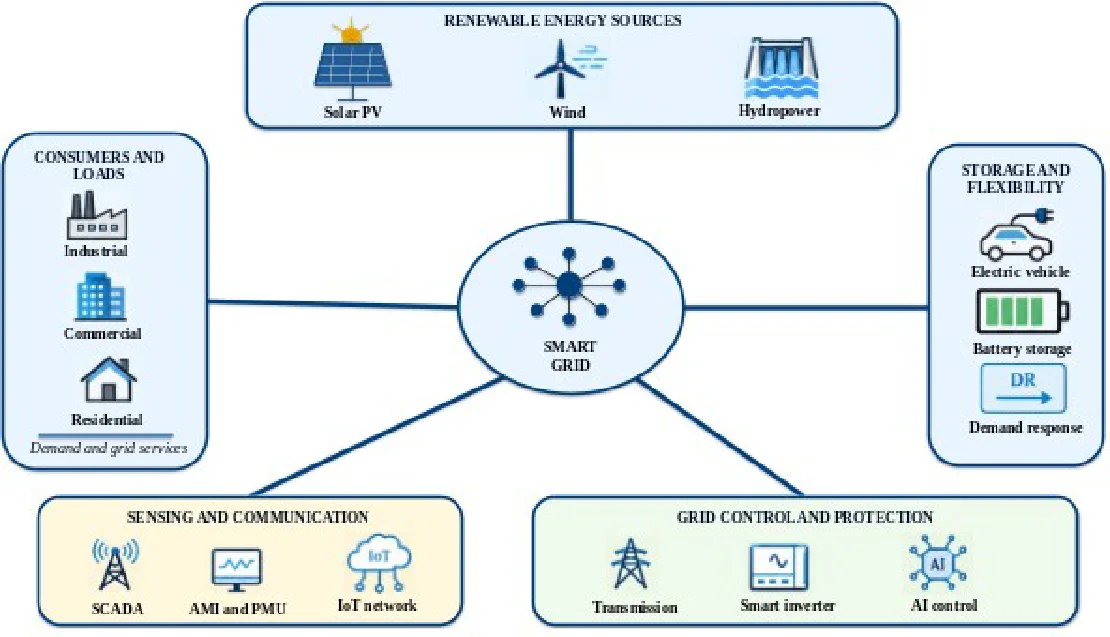
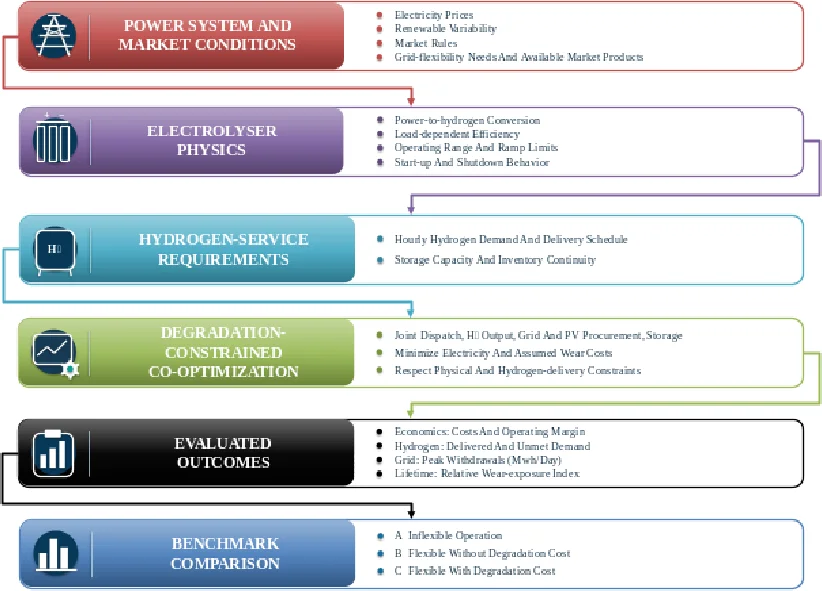
Models of inverter dominated renewable grids must be able to capture the time-varying operating conditions while maintaining a clear representation of fast control interactions, limited energy reserves, and uncertain measurements. Decisions that can be supported by physics-informed digital twins can unlock their engineering value, but also represent a path to integrate electrical models with adaptive learning. This is a critical integrative review that brings together 45 selected publications on digital twins, physics-informed learning, converter dynamics, secure estimation, climate resilience and control assurance. Literature is arranged not only by algorithm name, but also by physical mechanism, modeling task and validation boundary. The synthesis is based on a clear description of the reference corpus as well as analytical perspectives of the frequency response, the measurement age, the inverter capability, the feedback delay, and the runtime supervision. With explicitly selected illustrative assumptions, the simultaneous voltage depression and current derating significantly reduce the active-reactive power envelope, and reduction of the aggregate inertia parameter from 6 to 2 s triple the initial rate of change of frequency. These are merely explanatory calculations that can be reproduced, by no means measured gains from a new trained twin. Three priorities are identified for the synthesis: 1) validation for the mechanism, 2) synchronization under constraints, and 3) testing the physical implications of information degradation under environmental stress. These priorities are linked through a runtime architecture and paired compound-event protocol to implementable research designs. The main message is that useful physics-informed twins need to balance model fidelity, available response capability, information quality, and decision deadlines; prediction accuracy alone does not guarantee stable or resilient operation of the renewable-grid.
Research ArticleGrid Stability and Digital TwinsIn progress
Physics-Informed Digital Twins for Inverter-Dominated Renewable Grids: A Critical Review of Stability, Operational Constraints, and Cyber–Climate Resilience
Correspondence: rahmanshahriyar0048@gmail.com
Abstract
Keywords physics-informed digital twininverter-dominated gridrenewable energyfrequency stabilityconverter capabilitycyber–climate resilience
1. Introduction
The integration of photovoltaic generation, wind power, and battery storage changes the dynamic structure of electrical networks. Converter controls determine synchronization, current injection, and disturbance response, while the connected energy resource constrains how long support can be sustained. Consequently, renewable penetration is not an adequate stand-alone descriptor of stability. Aggregate inertia, network impedance, controller configuration, power headroom, and protection behavior must be considered separately (Hatziargyriou et al., 2021; Li et al., 2022; Milano et al., 2018).
A digital twin can maintain a virtual representation of an evolving asset or system by reconciling models with operating measurements. In a renewable grid, this can support parameter identification, contingency screening, condition monitoring, and supervisory control. However, a conventional simulation, an automatically updated digital shadow, and a twin connected to a defined decision process represent different capabilities. Their distinction concerns data integration and operational purpose, not the complexity of a dashboard (Jones et al., 2020; Kritzinger et al., 2018; Rasheed et al., 2020).
Physics-informed learning provides several mechanisms for constructing such representations. Differential equations can be introduced as training constraints; network connectivity can structure the learner; and data-driven corrections can supplement incomplete physical models. These approaches are attractive when labeled trajectories are expensive to generate. Nevertheless, their usefulness depends on whether the supplied physics represents the phenomenon of interest and whether training produces a sufficiently accurate approximation over the required domain (Karniadakis et al., 2021; Raissi et al., 2019; Wang et al., 2021, 2022).
Recent power-system applications extend from forward and inverse dynamic modeling to component-based simulation, state estimation, converter synchronization assessment, and converter fault-control studies (Misyris et al., 2020; Taul et al., 2020; Nellikkath et al., 2024; Ngo et al., 2024; Stiasny et al., 2024). Wind-field twins and broader power-system digital-twin frameworks address complementary renewable-energy functions (Song et al., 2023; Zhang & Zhao, 2023). Their outputs are not interchangeable: an accurate production forecast cannot establish phase-locked-loop stability, and a feasible supervisory representation cannot establish fault ride-through capability.
General physics-informed methods and applications of digital twins in power and energy systems have already been discussed in other existing reviews (Cuomo et al., 2022; Heluany & Gkioulos, 2024). The novelty here is thus a synthesis from a mechanism point of view of what the twin should represent for its output to be used to inform electrical operation. It brings together a critical analysis of diverse studies, while also presenting clear calculations to reveal the connection between inertia, measurement age, converter limits, and feedback delay. The calculations are used as engineering explanations not as replacements for the experimental evidence reviewed.
Research objective. The core goal of this critical integrative review is to understand how to evaluate physics-informed digital twins in inverter-dominated renewable grids by synthesizing the evidence on electrical stability, physics-informed modeling, operational constraints, information integrity, timings and cyber-climate resilience. Specifically, the review will aim at: O1) defining and characterizing the physical states, constraints, and dynamic mechanisms that a twin should represent for different inverter-dominated grid stability tasks; O2) critically assessing what existing physics-informed and digital-twin studies actually validate and what are the limits of their demonstrated applicability; O3) examining how measurement degradation, cyber threats, climate stress, and operational limits affect the physical decision problem; and O4) developing a constraint-aware runtime architecture and a mechanism-specific framework for validation.
Novelty and contribution. While there are several existing reviews on physics-informed methods and power-system digital twins (Cuomo et al., 2022; Heluany & Gkioulos, 2024), these works are generally not discussed in the context of converter-specific stability limits, information-age effects, and end-to-end decision timing. The novelty of this review is that these dimensions are combined here in a single decision-centred engineering framework, instead of structuring previous work mainly based on the learning architecture or application label. It also provides a set of reproducible analytical lenses for frequency response, measurement age, active-reactive power capability, and feedback delay, and renders the synthesis into a constraint-aware run-time supervision architecture and a matching validation protocol. These contributions are not evidence of a newly trained/experimentally deployed Digital Twin but review-derived and analytical.
Research questions. RQ1: What are the physical mechanisms and states that need to be preserved for various stability requirements in inverter dominated renewable power grids? RQ2: What is supported by existing validation studies and what is not within their scope? RQ3: What are the electrical constraint and decision quality changes that are measurable as a result of cyber and climate stress? The answers to these questions result in a validation agenda focusing on frequency response, synchronization, capability limits, information quality, timing and critical-load service. A separate critical literature review in Section 3 sets off the previous evidence for the following mechanism-specific engineering synthesis and analytical examples.
2. Critical Literature Review
2.1. Digital twin concepts and physics-informed modeling
Physics-informed machine learning offers multiple paths to leveraging data with governing equations. PINNs extended the concept of differential-equation residuals to the learning objective for forward and inverse problems, and later extended it to more physics-informed learning and operator-learning formulations (Raissi et al., 2019; Karniadakis et al., 2021; Lu et al., 2021). The advantages of these approaches in the context of power systems are that whole trajectories with labels may be costly to produce and that there is already strong structural knowledge in electrical networks. However, the literature also highlights key limitations in optimization, such as the presence of competing residual terms, which can lead to gradient pathologies, and the neural-tangent-kernel analysis, which explains why some PINN formulations do not train reliably in challenging regimes (Wang et al., 2021, 2022). Bayesian formulations introduce uncertainty representation, which, however, is conditional on uncertainty representation in the assumed model and likelihood (Yang et al., 2021).
Power-system studies have progressed from demonstrating generic feasibility to dynamic identification and coupled simulation. Misyris et al. (2020) demonstrated physics-informed forward and inverse modeling for power-system dynamics, while Stiasny et al. (2021) pushed forward this approach to nonlinear system identification. Later, time-domain PINN studies quantified accuracy, computational cost and flexibility, and PINNSim incorporated learned components into power-system dynamic simulation (Stiasny & Chatzivasileiadis, 2023; Stiasny et al., 2024). These contributions show that physics-informed models can help speed up or supplement certain calculations, but they also reveal two open questions for the deployment of digital twins. First, identifiability is also dependent on the placement of measurements, excitation, and model structure. Second, numerical compatibility to a simulator does not necessarily mean a trustworthy synchronisation to an evolving physical asset. Therefore, besides one-step prediction accuracy, model error, parameter uncertainty, topology reconciliation and update latency have to be assessed separately.
2.2 Inverter-dominated stability and converter-aware modeling
The stability literature reveals that a single, overall notion of renewable penetration is not a suitable way of describing inverter dominated grids. There are modern classifications that differentiate from conventional frequency and voltage phenomena the instability phenomena related to a converter, and those related to resonance (Hatziargyriou et al., 2021). Low-inertia behavior alters the initial frequency response after a power imbalance while weak-grid synchronization is highly dependent on network impedance and converter control structure (Milano et al., 2018; Ray, 2021). The two types of converters, grid-following and grid-forming, have different synchronization philosophies and control behaviors, with neither type being free from current-limits, source-energy constraints, or network interactions (Li et al., 2022; Rosso et al., 2021). Recent grid forming overcurrent limiting reviews further highlight that the design of current limit impacts on voltage support, fault behavior, transient stability and post fault recovery (Baeckeland et al., 2024).
Physics-informed applications are starting to consider converter specific mechanisms. Using recurrent physics-informed modeling, transient assessment and attraction-region analysis of a PLL has been performed (Nellikkath et al., 2024). Complementary converter research has indicated that the grid-forming current-limiting options have significant impact on fault behaviour and recovery, and a detailed simulation and experimental evaluation of voltage mode current limiting control (Taul et al., 2020). Nevertheless, the evidence is specific to tasks. While a model that is validated for PLL trajectories doesn't guarantee grid-wide frequency security, nor does a current-limiting controller ensure that a digital twin is synced with the operational asset. The literature thus suggests that there is a need for a multi-layered validation procedure, where the different decision boundaries are frequency response, synchronization, current limit transitions, voltage feasibility, and energy availability.
2.3 State estimation, verification, and cyber-resilient digital twins
State estimation plays a key role in the digital twin since decision making in the operation is related to the quality and the age of the reconstructed system state. Dynamic state-estimation research separates the functions of tracking, parameter estimation and prediction, and has different observability and uncertainty requirements (J. Zhao et al., 2019). Recently, physics-informed graphical learning has shown great promise in physics state estimation, such as in power systems, where network relationships are incorporated into the learning process (Ngo et al., 2024). But physical consistency does not necessarily imply measurement trust. A survey of false data injection attacks reveals that coordinated attacks can maintain the conventional residual structure, and the detectability relies on the measurement structure, the defence assumption and the attacker access (Deng et al., 2017; Liang et al., 2017; Aoufi et al., 2020). The more general literature on cyber-physical-system security also focuses on the explicit threat models and protection boundaries (Humayed et al., 2017).
However, verification literature offers additional protections and is limited in scope. A formal verification can certify the neural-network behaviour over a specified input domain while physics-informed optimal-power-flow work can assess static feasibility or worst-case violation of constraints (Venzke & Chatzivasileiadis, 2021; Nellikkath & Chatzivasileiadis, 2022). Ames et al., (2017) and Dawson et al., (2023) also link machine learning with safety conditions of a dynamical system using learned Lyapunov and barrier-certificate approaches respectively. These guarantees are still propertywise, in the sense that the verified static mapping is not sufficient to guarantee stability after embedding in a delayed feedback loop, and that the low residual is not sufficient to verify a corrupted measurement stream. Cyber resilience thus needs to be explicitly addressed for digital twins, including considering time-stamps, replay, missing data, command integrity, model updates, and the impact of taking an unsafe recommendation.
2.4 Climate resilience and compound operational stress
Climate-resilience research has demonstrated that environmental hazards have identifiable physical pathways that impact power systems, and not a generic uncertainty term. Extreme weather events can affect topology, asset availability, restore difficulty and operating conditions for which generation and network equipment operate (Panteli & Mancarella, 2017; Jufri et al., 2019). A wider climate-energy review reveals that climate effects can affect the capacity of the energy supply and the operation of infrastructure (Cronin et al., 2018). For renewable-energy applications, physics-informed wind-field twins and power-system digital-twin frameworks offer a way to map the evolving operating information to a forecast or to a supervisory representation (Song et al., 2023; Zhang & Zhao, 2023). The key point about integration is whether or not those environmental inputs change the electrical model, in terms of resources, rating, topology, or operating limits.
Concurrent stresses are also not necessarily super-additive, as is warned in compound-event literature. Climate events in the same time or space are said to be compound events, and the effect of the compound events varies with the outcome and event sequence (Zscheischler et al., 2018). Digital-twin cybersecurity testbeds showcase how an attack and countermeasure can be simulated on an electric-power twin, but the successful security test alone does not prove preservation of fast converter stability (Kandasamy et al., 2022). A defensible cyber-climate evaluation should thus be carried out using matched cases without stressor, with stressor only, and with both stressors, and should include event timing and explicit physical outcomes as frequency excursion, current-limit activation, infeasible command, critical-load loss, and recovery time.
2.5 Critical synthesis and research gap
In all these oeuvres, it is fragmentation that is the main constraint and not methodological lack of innovation. Digital-twin studies focus on synchronization and the operational linkage; physics-informed learning studies focus on the model structure and data efficiency; converter studies focus on stability with regard to the mechanism; cyber-security studies focus on adversary models and trustworthy estimation; and climate-resilience studies focus on hazard pathways and service restoration. Despite the availability of existing reviews that offer interesting syntheses of general physics-informed methods and power-system digital twins (Cuomo et al., 2022; Heluany & Gkioulos, 2024), the evidence still does not provide a compact engineering framework that explicitly relates the model fidelity, information quality, converter capability, timing, and exact decision boundary being protected.
In this review, we try to bridge this gap by structuring the evidence based on the physical mechanism and operational decision, rather than only on the labels of the algorithms. It queries the states and constraints a twin needs to keep, what the mentioned validation really shows, and how cyber or climate stress affects the physical decision problem. Application evidence that has been informed by physics, cyber-climate stress pathways, analytical engineering lenses, and a runtime supervision architecture are therefore addressed in the following sections, moving from mechanism-specific electrical requirements. Analytical calculations are only used to make the review criteria auditable and not replace experimental validation. This framework aims to separate proven achievements from projections and to establish a more precise program of validation for physics-informed digital twins for inverter-dominated renewable energy grids.
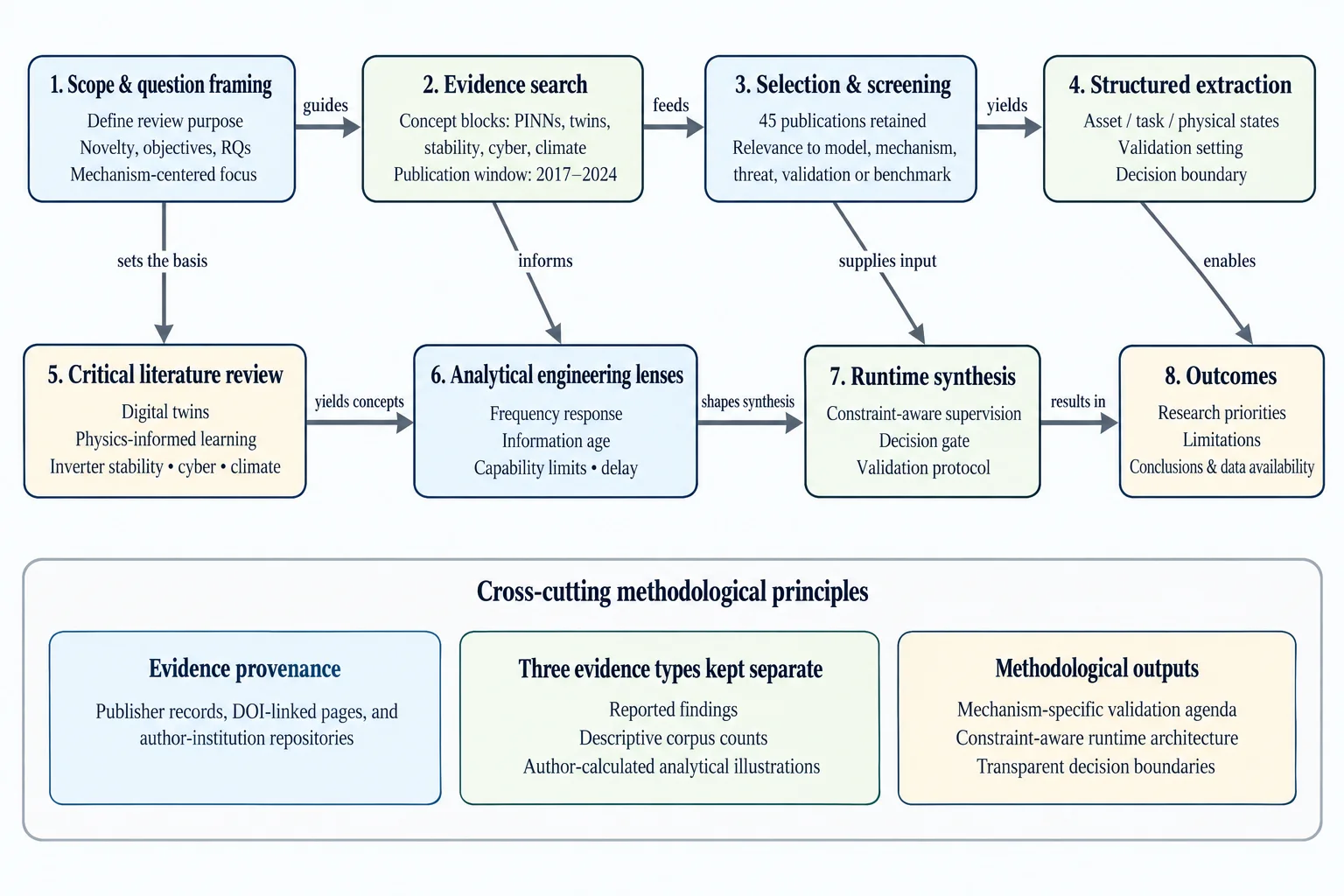
3. Review Design and Evidence Provenance
This is a structured critical integrative review, rather than a comprehensive systematic review or statistical meta-analysis. Such design is suitable for a question that traverses control theory, machine learning, power electronics, estimation, and climate-risk analysis, studies that use incompatible outcomes and test systems (Snyder, 2019; Xiao & Watson, 2019). The idea is not to calculate an overall benefit of digital twins, but to compare the engineering claims and supporting evidence.
The corpus consists of 45 chosen peer-reviewed articles from the past seven years (2017-2024). Bibliographic and technical evidence is provided by publisher records, DOIs and by author-institution repositories. Search concepts include physics-informed learning or PINNs, digital twins, state estimation or dynamic simulation, inverters, grid-forming control or power-system stability, and cyberattack, climate or resilience. The publication year limitation is applied on the record level: Studies that were published before 2017 or after 2024 are not included in the analytical corpus or in the reference list. Where foundational concepts are older, the review is based on 2017-2024 review or synthesis papers which restate the principles. Each source is listed in the supplementary reference register with the basis of access and analytical role.
Inclusion must be published between 2017 and 2024 inclusive, and a relevant model, method, converter mechanism, measurement relationship, threat model, hazard pathway, assurance technique or reproducible benchmark. Extraction relates to the modelled asset, the task, the physical information, the validation setting and the decision boundary which applies. Based on an abstract, detailed quantitative performance is not assumed. For those instances in which no more than a bibliographic record or abstract was found, the synthesis is restricted to the stated task and scope. Unreported capabilities are not considered as proven absences.
Note. Review-derived workflow summarizing how the paper moves from scope definition and evidence selection to critical synthesis, analytical lenses, and runtime-validation recommendations. It complements, and does not replace, the detailed prose description in Section 2.
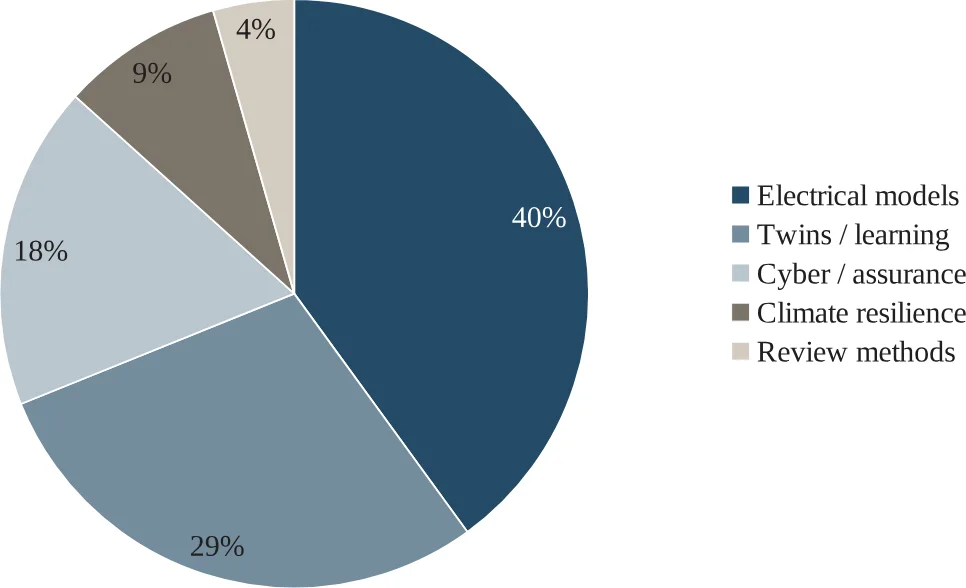
Figure 1 groups the references into five mutually exclusive primary categories. The electrical category contains power-system foundations, learning applications, benchmark tools, and inverter capability analysis. The twin-and-learning category combines twin concepts with general physics-informed methods. The remaining categories cover cyber and formal assurance, climate resilience, and review methodology. The original finer thematic assignments are preserved in Supplementary Material S1 so that this aggregation can be inspected and changed.
Note. Each reference has one primary grouping (n = 45). Electrical models and applications include power-system foundations, learning applications, benchmark tools, and converter capability. Counts describe this selected corpus, not field-wide publication prevalence. Data: S1, References and Corpus.
These proportions describe the coverage of this selected corpus, not the prevalence or maturity of the wider field. No exhaustive Scopus export, complete Google Scholar search, independent dual screening, or PRISMA selection flow is claimed. Source accessibility and purposive selection limit completeness. Conversely, retaining recent syntheses of foundational concepts prevents the review from treating established estimation and control principles as newly introduced by digital twins.
Three evidence types are kept separate throughout the paper: reported findings from the literature; descriptive counts of the reference register; and author-calculated analytical illustrations. Section 7 supplies every assumption needed for the illustrations, and S1 supplies formulas and chart data. No new neural network is trained, no hardware experiment is performed, and no electromagnetic-transient simulation is presented. Cross-study accuracy and speedup values are not pooled because their physical models, horizons, computational platforms, and baselines differ.
4. Electrical Mechanisms That a Twin Must Resolve
4.1. Inverter dominance is not a single stability problem
Low aggregate inertia affects the rate at which the frequency moves in the first few seconds following a power imbalance. Weak-grid behavior is related to the interaction between network impedance and converter synchronization/control, on the other hand. These may overlap, but also are not synonymous. Even a system with ample reserves of energy can have poor converter damping, and a locally well-controlled inverter cannot indefinitely accommodate an energy shortage (Li et al., 2022; Milano et al., 2018; Ray, 2021).
Grid-following (GF) controls typically use a phase-locked loop (PLL) to track a grid reference, while grid-forming (GF) controls use an internal voltage-angle reference. Not all grid-forming controllers are insensitive of network conditions, the distinction does not imply this. Current limiting, inner-loop dynamics and interactions between units are still important. Virtual-synchronous-machine and synchronverter-type approaches are able to emulate selected synchronous-machine behavior, but the behavior is still dependent on the current capability and available source energy (Tozak et al., 2024; Rosso et al., 2021).
The new power-system stability classification includes converter-driven and resonance-related phenomena, in addition to the traditional classifications (Hatziargyriou et al., 2021). A useful twin specification should therefore start with the instability mechanism and required observable, rather than with a preferred learning architecture. Representative mechanisms and their associated model content and evaluation quantities are related as shown in Table 1. The categories can overlap; the table is a guide to selecting the model and not necessarily an exhaustive list of failure categories.
Table 1
Electrical Mechanisms, Model Content, and Evaluation Quantities
| Mechanism | Required model content | Decision-relevant evaluation |
|---|---|---|
| Aggregate frequency | Power imbalance, inertia, damping, reserve headroom, and response activation. | Initial RoCoF; frequency excursion; support duration; response deadline. |
| GFL synchronization | PLL states and gains, terminal voltage, network impedance, and current injection. | Angle recovery; synchronization loss; sensitivity to voltage and grid strength. |
| GFM limit transitions | Internal angle/voltage control, current limiter, source energy, and mode logic. | Limit activation; feasible voltage support; recovery after mode switching. |
| Converter–network interaction | Frequency-dependent converter and network impedances; relevant control loops. | Oscillatory modes, damping, and stability margins for the stated loop. |
| Voltage and service feasibility | P–Q limits, operating voltage, topology, storage state, and critical-load demand. | Constraint violation; available headroom; critical-load energy not supplied. |
Note. Mechanisms can interact. Synthesis informed by Hatziargyriou et al. (2021), Li et al. (2022), Milano et al. (2018), Ray (2021), and Baeckeland et al. (2024). GFL = grid-following; GFM = grid-forming.
4.2. States, limits, and model resolution
A mechanism-specific twin requires the states that control the decision to be made. Aggregate power balance and reserve response might be necessary to assess frequency. Angle, frequency, controller integrator states, and a model of the grid impedance may be needed for converter synchronization. For capability assessment, terminal voltage, current limits, active power available and reactive power obligations are also needed. It would be a mistake to consider all these quantities as freely adjustable control variables, as this would overestimate the possible response.
For storage supported inverters, State of Charge (SoC) and available energy are also relevant in addition to the instantaneous power. Changes of operating rates, for weather exposed assets, should be included in the admissible operating set and not just as an external forecast. A set of grid-forming current-limiting studies reveals that voltage support, current limiting, transient stability, and post fault recovery are interlinked with the chosen limiting strategy (Baeckeland et al., 2024). A current circle is thus just one of the possible operating envelopes.
The resolution of the model should be consistent with the decision. A steady-state power-flow representation can be used to provide a feasibility for operating points but cannot solve switching transients. A reduced-order converter model might be able to capture the synchronization but not the high-frequency behavior. More detail does not necessarily help: poor identification of parameters and excessive execution time may outweigh extra model states. For the case where these three functions are packaged as a twin, there are established distinctions between state tracking, parameter identification, and prediction provided by the dynamic state-estimation research (J. Zhao et al., 2019).
5. Physics-Informed Learning and the Application Evidence
5.1. A common modeling representation
A switched differential-algebraic representation provides a useful organizing language for coupled network and converter models:
ẋ = f_σ(x, z, u; θ, d), 0 = g_σ(x, z, u; θ, d) (1)
In this case, x is composed of dynamic states, z of algebraic variables, u of controls, θ of uncertain parameters and d of external disturbances. The index σ indicates the active topology and the control mode. A learner need not replace the network solver, only a component function, or only estimate θ, or correct a reduced model. The compatibility of the learned blocks with algebraic coupling and integration scheme is explained through component-based and time-domain physics-informed simulation studies (Stiasny & Chatzivasileiadis, 2023; Stiasny et al., 2024).
A representative physics-informed training objective combines observation error with dynamic, algebraic, and initial-condition residuals:
L = λ_y L_y + λ_f L_f + λ_g L_g + λ_0 L_0 (2)
The weights λ are to weight dimensionless residual terms. Scaling is significant because if not scaled, voltage, angle, frequency and current errors will enter in different numerical magnitudes. Hard and soft architectural constraints and soft loss penalties are also different: soft loss penalties do not require exact feasibility between samples. The desired physical constraints might not be learned well due to gradient competition or training pathologies (Raissi et al., 2019; Wang et al., 2021, 2022).
Parameter identification introduces an additional issue. Several combinations of uncertain loads, damping, and controller gains can reproduce similar trajectories. Physics-informed identification uses model structure to exploit observations, but observability and excitation still determine which parameters can be distinguished (Misyris et al., 2020; Stiasny et al., 2021). A twin should label parameters as identified, assumed, or externally supplied, and should retain uncertainty when the data do not establish a unique value.
5.2. Architecture choices and appropriate uses
There are different tasks that can be solved using trajectory-based PINNs, operator learners, graph-based estimators, and hybrid correction models. DeepONet is not an operator-based surrogate itself, but it learns mappings between functions and provides a base for surrogates of operators (Lu et al., 2021). Although spatial electrical relationships can be embedded in graphical learning as is done in the case of state estimation, a graph-aware steady-state estimator is not necessarily a dynamic stability model (Ngo et al., 2024).
Bayesian physics-informed methods model uncertainty given some probability assumptions (Yang et al., 2021). This uncertainty should be evaluated close to key constrains and for varying measurement quality for grid operation. There are a number of different sources of uncertainty: observation noise, parameter uncertainty, model discrepancy, configuration change. If the model family does not include the active limiting mechanism, an interval based on the routine operating points can be misleading during a fault.
Hybrid designs are therefore appealing in environments where there are already trusted network solvers and protection models. A learned component can speed up a calculation that is repeated, but conventional equations can enforce network coupling. The engineering comparison need not only be the execution time for one forward pass, but also include initialization, retraining, topology reconciliation and error accumulation. While the contribution of modular integration is substantive, a simulator becomes an operational twin only when the relationship between the identified asset and decision process is defined (Rasheed et al., 2020; Stiasny & Chatzivasileiadis, 2023; Stiasny et al., 2024).
5.3. What representative studies establish
Table 2 compares ten primary applications by task and decision boundary. The table deliberately does not rank the studies: an estimator, a transient surrogate, and an energy-management controller solve different problems. Its purpose is to show where electrical and operational integration is required beyond the reported component capability.
Table 2
Representative Primary Applications and Their Decision Boundaries
| Study | Task and reported evidence | Boundary for grid operation |
|---|---|---|
| Misyris et al. (2020) | Physics-informed forward and inverse modeling of power-system dynamics. | Dynamic approximation does not establish continuous asset synchronization. |
| Stiasny et al. (2021) | Nonlinear parameter identification from observed dynamic responses. | Identifiability depends on model structure, measurements, and excitation. |
| Stiasny et al. (2024) | Component-based physics-informed simulation of coupled dynamics. | Simulator integration still requires operational state and topology tracking. |
| Nellikkath et al. (2024) | Recurrent modeling for PLL transient assessment and reduced-model attraction regions. | The stated converter model and envelope do not establish grid-wide stability. |
| Stiasny and Chatzivasileiadis (2023) | Physics-informed time-domain simulations comparing accuracy, computational cost, and flexibility. | Fast trajectory approximation does not establish continuous real-time asset synchronization or topology tracking. |
| Ngo et al. (2024) | Physics-informed graphical learning for power-system state estimation. | Estimation accuracy does not establish fast converter-control stability. |
| Taul et al. (2020) | Grid-forming current-limiting control with detailed simulation and experimental evaluation. | Fault-mode current limiting is a converter-control result, not evidence of physics-informed twin synchronization. |
| Nellikkath and Chatzivasileiadis (2022) | Physics-informed AC optimal power flow and worst-case constraint analysis. | Static constraint feasibility is different from transient stability. |
| Zhang and Zhao (2023) | Physics-informed digital twin of wind farms for data-driven physical inference. | Wind-field or asset-level prediction does not establish converter synchronization or fault ride-through. |
| Kandasamy et al. (2022) | Electric-power digital twin for cybersecurity testing, attack emulation, and countermeasure research. | Cybersecurity test-bed fidelity does not establish closed-loop electrical stability under attacked measurements. |
Note. Qualitative comparison, not a ranking or pooled effect estimate. HIL = hardware-in-the-loop. Source-access limits and exact DOI records are retained in S1.
The progression of the application evidence is from isolated trajectory prediction to identification and coupled simulation. The studies about the use of learned dynamic components in network computation, such as Time-domain PINN and PINNSim, are still ongoing. Physics-informed prediction has further been applied to recurrent behaviour of trajectories and to attraction-region assessment, which are converter-specific works (Nellikkath et al., 2024; Stiasny & Chatzivasileiadis, 2023; Stiasny et al., 2024). These contributions are particularly pertinent if a large number of operating conditions need to be screened, but the validated model domains are part of the result.
The other difference is related to the property being verified. A learned AC optimal-power-flow mapping is an approach for worst-case constraint assessment that addresses static feasibility. Formal verification can be used to bound the behaviour of a neural network for a given domain of inputs. After embedding the mapping in a delayed physical feedback loop, neither of these results implies nonlinear stability (Nellikkath & Chatzivasileiadis, 2022; Venzke & Chatzivasileiadis, 2021). For the learned Lyapunov/barrier candidates, the decrease/invariance conditions need to be verified, with admissible controls and model assumptions (Ames et al., 2017; Dawson et al., 2023).
This evidence indicates that there is a practical division of labor. Physics-informed modelling can be used to inform rapid prediction, identification or screening, traditional modelling and reference solvers can be used to give comparison trajectories and property-specific verification can limit the recommendations chosen. The key is not which layer has the most advanced algorithm, but whether their interfaces maintain the physical property and time requirement that the operator requires.
6. Cyber and Climate Stress as Changes in the Decision Problem
6.1. Measurement consistency versus measurement trust
A twin can be physically consistent with corrupted information. In a linear measurement model y = Hx + v, a coordinated injection a = Hc can be interpreted as a state shift c. If the estimate shifts accordingly, the residual satisfies:
r_a = (y + Hc) - H(x̂ + c) = y - Hx̂ = r (3)
This algebraic design is the reason for a physical residual to be unable to validate measurements (Liang et al., 2017). The detectability is not just a function of whether or not an electrical equation is in a loss function, but also a function of measurement structure, attacker access, and trusted information. These assumptions are clearly made in false-data-injection surveys and used to generate suitable baseline data for the assessment of a physics-informed detector (Deng et al., 2017; Aoufi et al., 2020).
Replay, packet loss, manipulation of timestamp, and corruption of the command should be considered separately as they impact different portions of the observation–decision–actuation path. Explicit threat models are helpful in expressing the attacker's knowledge and control (Humayed et al., 2017). An adaptive twin introduces extra interfaces to safeguard through parameter updates and model-version changes. If the updates are too aggressive, then corrupted measurements can be "absorbed" in the updates; if the model is "frozen," then the obsolete operating representation may be retained.
The relevance of the applications is that digital-twin cybersecurity testbeds can be used to emulate attacks and test countermeasures, but successful testing does not guarantee preservation of fast converter synchronization (Kandasamy et al., 2022). Evaluation should therefore be linked to physical results: the frequency or voltage error, unsafe recommendations accepted, recovery after trustworthy measurements return, and false interventions during actual electrical disturbances.
6.2. Environmental stress and electrical consequences
Climate information becomes useful for grid stability if it alters an identifiable condition in the electrical grid. Available generation and headroom is affected by resource scarcity, operating ratings are affected by heat-related restrictions, and topology and the impedance seen by surviving converters is affected by infrastructure damage. These are not the only pathways, but are motivated by power-system resilience and climate-energy studies (Panteli & Mancarella, 2017; Cronin et al., 2018; Jufri et al., 2019).
Wind-field inference and other power-system digital-twin frameworks can be used at useful but distinct physical layers (Song et al., 2023; Zhang & Zhao, 2023). They need explicit interfaces with the electrical dynamics: a forecast should change a power-availability constraint, or an operating point; an asset restriction should change an admissible limit. Otherwise, awareness of climate change can be a label that is pasted on an unchanged grid model.
A compound climate event is an event that is caused by interactions between environmental drivers in time or space (Zscheischler et al., 2018). Instead, a cyberattack that happens during a heatwave is a joint cyber–climate stress scenario, and there is no causal link between the occurrence of hazards and attacks. The relevant engineering question is whether the information degradation affects the impact of a given physical disturbance. Several relevant constraints are shown in Section 7 and how to test interaction effects without assuming them to be necessarily harmful or super-additive is shown in Section 8.
7. Analytical Engineering Lenses for Reviewing Digital Twins
7.1. Purpose and reproducible assumptions
The following calculations make the review's evaluation criteria physically interpretable. They are author-generated analytical illustrations based on elementary aggregate frequency dynamics, balanced-system apparent power, and pure-delay phase response. They are not fitted to an operating grid, not outputs of a trained twin, and not evidence of controller superiority. Table 3 defines their common assumptions; S1 contains the complete numerical series and editable formulas.
Table 3
Declared Assumptions for the Analytical Illustrations
| Quantity | Selected value or range | Interpretation and boundary |
|---|---|---|
| Frequency / damping | f₀ = 50 Hz; D = 1 | D is pu power per pu frequency; an illustrative aggregate parameter. |
| Aggregate inertia | H = 2, 4, 6 s | Heatmap extends to H = 1, 3, 8 s; no spatial dynamics are represented. |
| Step power deficit | Δp = 0.05, 0.10, 0.15 pu | Frequency and age analyses use 0.10 pu; no added reserve response. |
| Frequency-error budget | b = 0.20 Hz | Chosen tolerance for a held pre-event sample, not an operating standard. |
| Voltage / current limit | V = 1.00 or 0.80 pu; Imax = 1.20 or 0.90 pu | Assumed restriction; no empirical temperature-to-current relationship. |
| Reactive obligation | Q = 0.30 pu | Used for active-power capability comparison on consistent bases. |
| Pure feedback delay | τ = 1, 5, 10 ms; ν = 1–100 Hz | Additional phase lag only; no complete transfer function is inferred. |
Note. All numerical values are selected explanatory assumptions, not measured grid or device parameters. Formula-based calculations are supplied in S1.
The aggregate frequency model is a model that does not include spatial or converter-specific dynamics. The P–Q calculation excludes modulation, DC-source, thermal-transient and stability limits, other than the specified current limit. The delay calculation is a pure delay and not a full closed loop transfer function. These restrictions are deliberate: each calculation is an isolation of a relationship which a more detailed twin must be able to represent or justify neglecting.
7.2. Inertia, power imbalance, and frequency response
Let x = (f − f₀)/f₀ denote per-unit frequency deviation. For an aggregate frequency model with inertia parameter H, damping D, a positive deficit Δp, and no additional fast support over the illustrated interval:
2H dx / dt = -Δp - Dx (4)
At the onset of a step deficit from nominal frequency, the magnitude of initial rate of change of frequency is:
|RoCoF(0⁺)| = f_0 Δp / 2H (5)
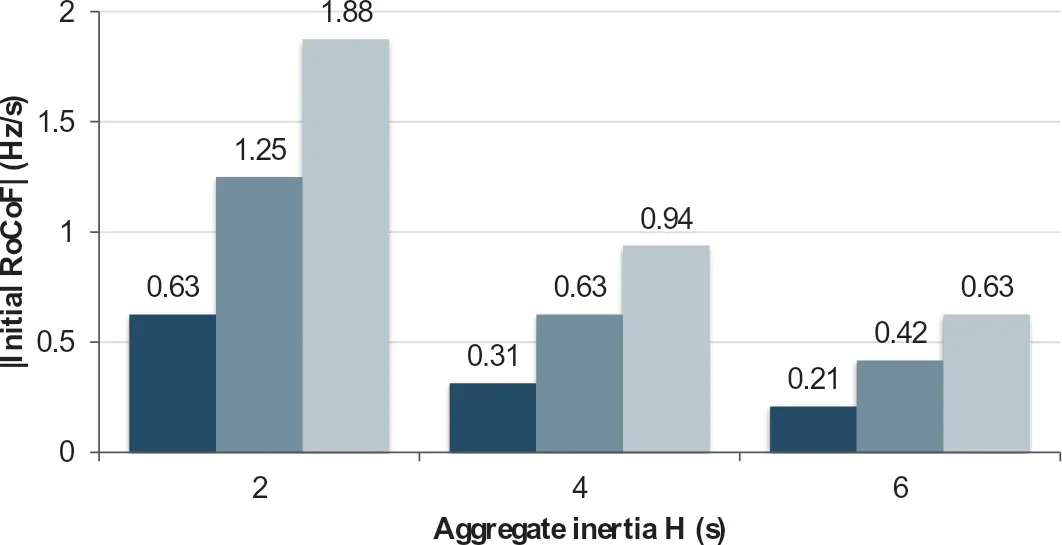
This expression is analyzed in Fig. 2 for three values of inertia parameters and three values of deficits. At Δp = 0.10 pu and f₀ = 50 Hz, the initial magnitudes are 1.250, 0.625, and 0.417 Hz/s for H = 2, 4, and 6 s, respectively. The threefold difference from the least to the most inertia cases is not assumed to be a learning improvement but is a result of the inverse relationship. It also illustrates the fact that the penetration of renewable is not enough to determine the required response deadline (Milano et al., 2018).
Note. Author-calculated from Equation (5), using f₀ = 50 Hz and a step power deficit. Values are initial magnitudes in Hz/s, not performance gains from a digital twin. Data: S1, Frequency.
For x(0) = 0 and constant positive D, the closed-form solution is:
f(t) = f₀ − (f₀Δp/D)[1 − exp(−Dt/(2H))] (6)
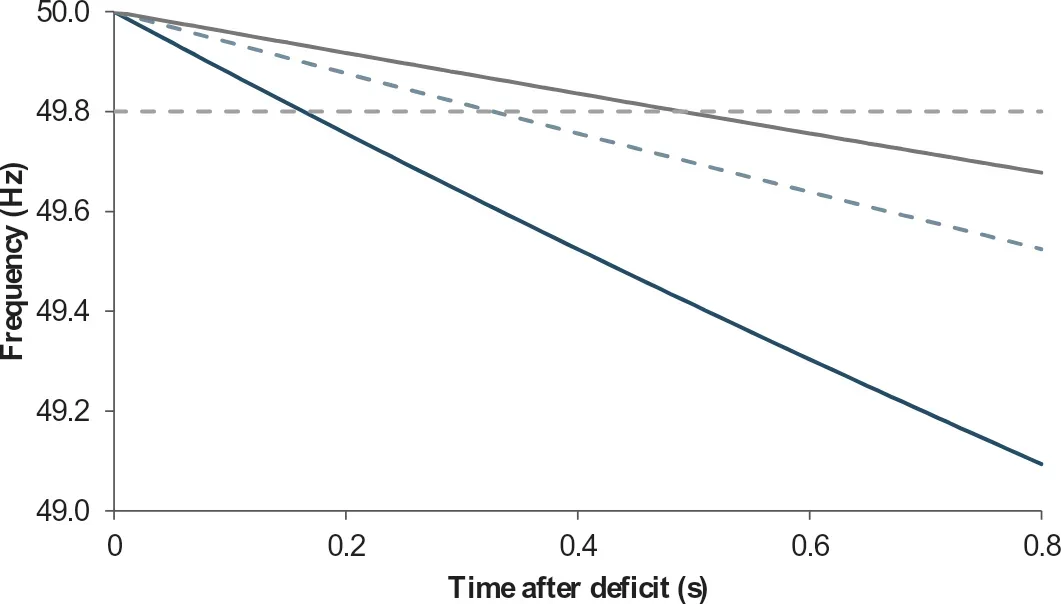
The same model is used in figure 4 to display the first 0.8 s following a 0.10-pu deficit. At 0.4 s, the calculated frequencies are approximately 49.524, 49.756, and 49.836 Hz for H = 2, 4, and 6 s. All these curves exhibit early frequency drop but damping only. They are not frequency-nadir or recovery predictions, as there are no governor responses, inverter support or protection actions included.
Note. Author's calculation based on Equation (6) with D = 1 pu power per pu frequency. Governor response, quick support and protection are missing. The 49.8Hz line is a guide only and not a grid code limit. Data: S1, Frequency.
The review implication for a twin is to break down the operating state error from the assumed response error. A match to the initial slope doesn't validate later restoration, a match to a damped aggregate trajectory doesn't validate local converter synchronization. The error metric of a benchmark should specify what segment and mechanism it refers to.
7.3. How stale data consume a frequency-error budget
If the last trusted sample is the nominal pre-event frequency and no dynamic prediction is used while it is stale, then the most recent sample will be used as the nominal pre-event frequency. The magnitude of Δf(τ) is the change that was not seen after an information age τ. Entering a selected budget of explanation b provides the crossing time:
τ_b = -2H / D ln[1 - Db / f_0 Δp] (7)
This expression is valid in the following range: 0 < Db/(f₀Δp) < 1. With b = 0.20 Hz and Δp = 0.10 pu, the crossing times are approximately 0.163, 0.327, and 0.490 s for H = 2, 4, and 6 s. The budget is a modelling tolerance not a grid code limit or a tested safe delay. Predictive state estimation could alter the error but the performance has to be assessed and not assumed.
Figure 5 shows the percentage of that budget that is missed for a larger range of inertia parameters and sample ages, as a percentage of the missed frequency change. For H = 2 s, a 100-ms age consumes about 61.7% of the budget, whereas 200 ms consumes about 121.9%. Hence, it is not possible to make an independent inference of a single acceptable telemetry interval.
Information age (ms)
| H (s) | 10 | 25 | 50 | 100 | 200 | 400 |
|---|---|---|---|---|---|---|
| 1 | 12.5 | 31.1 | 61.7 | 121.9 | 237.9 | 453.2 |
| 2 | 6.2 | 15.6 | 31.1 | 61.7 | 121.9 | 237.9 |
| 3 | 4.2 | 10.4 | 20.7 | 41.3 | 82.0 | 161.2 |
| 4 | 3.1 | 7.8 | 15.6 | 31.1 | 61.7 | 121.9 |
| 6 | 2.1 | 5.2 | 10.4 | 20.7 | 41.3 | 82.0 |
| 8 | 1.6 | 3.9 | 7.8 | 15.6 | 31.1 | 61.7 |
Figure 5. Sensitivity of a Selected Frequency-Error Budget to Information Age
Note. The missed frequency change is reported by cells as a percentage of a selected 0.20Hz budget for the pre-event nominal sample. The darker cells represent higher consumption; 100% represents the full use of the selected budget. Analytical illustration, not failure probability. Data: S1, InformationAge.
Model inference time is not the only appropriate digital-twin metric. This is the result of the measurement age, the estimation error, the model discrepancy and the delay before the proposed action is applied. The heatmap is not a probability of failure map, but rather a deterministic sensitivity map. Its purpose is to make the result of an announced information delay open to audit.
7.4. Inverter capability under coupled voltage and current restrictions
On consistent three-phase per-unit bases, the current-magnitude restriction gives a necessary apparent-power condition:
P^2 + Q^2 ≤ (VI_{max})^2; P_{max} = √((VI_{max})^2 - Q^2) (8)
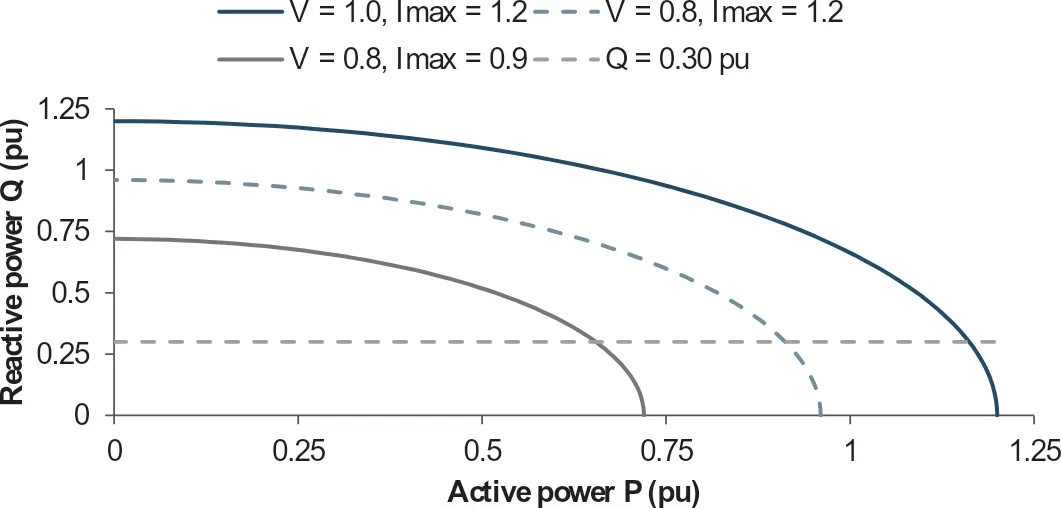
The positive-reactive-power boundary for three example operating conditions is plotted in Figur 6. The current only radius under 1.20 pu current and 1.00 pu voltage is 1.20 pu which contracts to 0.96 pu when the voltage is depressed to 0.80 pu. When an extra current restriction (0.90 pu) is selected, it shrinks to 0.72 pu. The latter limit is an assumed derated operation, no law of temperature-to-current is assumed.
Note. Positive-Q boundary as per Equation (8) on consistent per unit bases. The horizontal line is the line that marks the value of Q = 0.30 pu. Operation can be further limited by modulation, source-energy, current-limiting and stability constraints (Baeckeland et al., 2024). Selected Assumptions; Data: S1, Capability.
Table 4 considers the active power upper bound at a constant reactive power demand Q = 0.30 pu. The combined case allows about 0.655 pu while the baseline is 1.162 pu. A request for active power can thus turn out to be unfeasible even if the numerical value of this request is still the same. If a twin is able to update the renewable availability without changing the old terminal voltage or current limit, it can make a physically inconsistent recommendation.
Table 4
Active-Power Capability at a Fixed Reactive-Power Requirement
| Condition | V / Imax (pu / pu) | VImax (pu) | Pmax (pu) | Loss (pu) |
|---|---|---|---|---|
| Baseline | 1.00 / 1.20 | 1.200 | 1.162 | 0.000 |
| Voltage only | 0.80 / 1.20 | 0.960 | 0.912 | 0.250 |
| Current only | 1.00 / 0.90 | 0.900 | 0.849 | 0.313 |
| Combined | 0.80 / 0.90 | 0.720 | 0.655 | 0.507 |
Note. In each case Q = 0.30 pu, with the loss being the reduction from the baseline Pmax. Values follow Equation (8). With unrounded values, the loss interaction is −0.056 pu, which is a capacity value, not an estimate of system-risk.
However, a full grid-forming capability envelope might be smaller as voltage generation, modulation, source energy, current limiting, and stability also limit operation (Baeckeland et al., 2024). The plotted circle should not be considered a full safe operating region. It is meant to reveal the elementary relationship between voltage support and active-power headroom, prior to the application of these other restrictions.
The four cases also demonstrate a cautionary reminder regarding compound effects. The interaction contrast is roughly equal to −0.056 pu, if loss is defined as the decrease of the calculated active-power bound. So, the capability reduction is sub-additive on this particular scale even if it is larger than either of the capability reduction. This is not an indicator of a decrease in compound-event risk; it is an indicator of the fact that an interaction claim needs to be based on a defined outcome and baseline instead of an assumption that all coupled stresses are super-additive.
7.5. Feedback delay and the frequency of the controlled interaction
A pure delay τ contributes a frequency-dependent phase lag. At an oscillation frequency ν in hertz, its magnitude is:
|φ(ν)| = 360ντ (9)
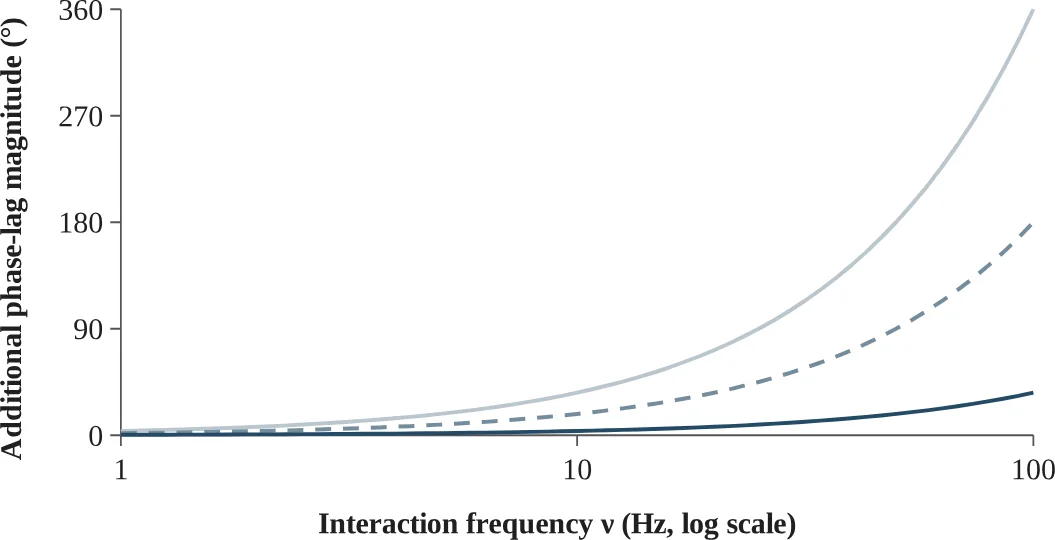
This relationship is tested in Figure 6, in the range of 1–100 Hz. At 10 Hz, delays of 1, 5, and 10 ms add phase-lag magnitudes of 3.6°, 18°, and 36°, respectively. At 50 Hz, a 5-ms delay contributes 90°. This is not a claim that all the controllers run at the electrical fundamental frequency, but the frequency here is the interaction or modulation frequency that is used in the frequency-response analysis.
Note. Calculated from Equation (9). The x-axis is the frequency of the interaction analysed in a logarithmic scale. The curves represent the pure-delay addition, not the phase margin of entire converter-grid loop. Data: S1, Delay.
The relevance is in architecture. A path suitable for slow supervisory redispatch may not be suitable for a faster feedback interaction. Impedance based analysis provides a driving force to inspect the frequency dependent converter–network behavior, the actual stability consequence however is dependent on the complete loop transfer function (Ray, 2021). These curves do not provide any gain or phase margin information. They separate the delay contribution that the designer of a controller must add when deciding where a learned model is safe to put in the hierarchy.
The five analytical views thus indicate different reporting needs: frequency response – inertia and deficit; state relevance – timestamp age; feasibility – voltage and current limits; and control integration – frequency dependent delay. No one can be substituted with only one trajectory-error figure.
8. Runtime Architecture and Validation Design
8.1. Separate fast electrical control from twin supervision
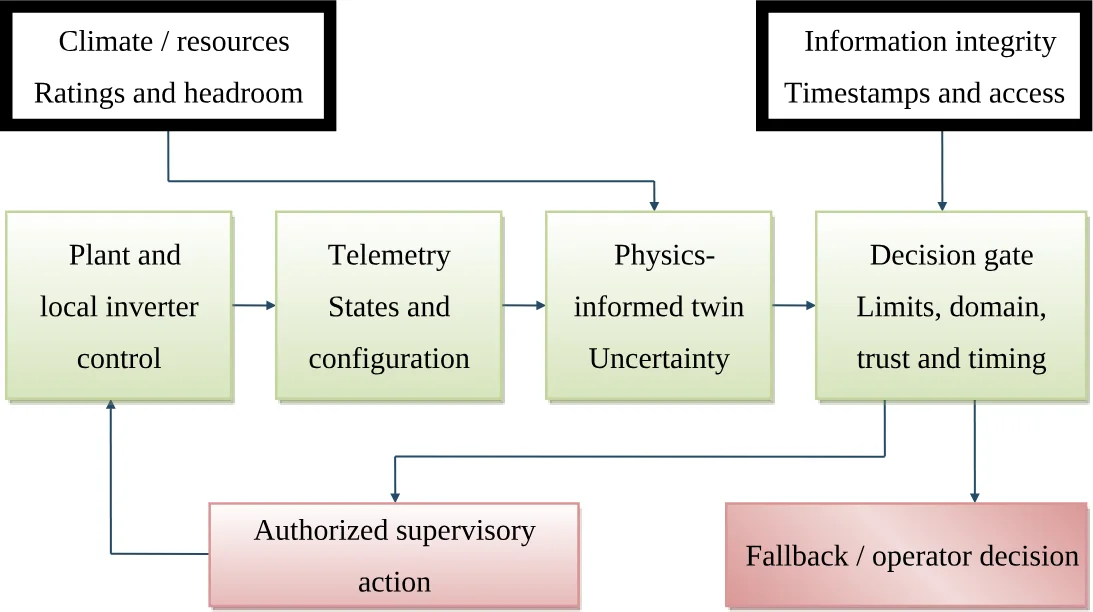
The synthesis results are summarized in one runtime architecture as shown in Fig. 7. The electrical plant and local control layer are still clearly indicated. Measurements and configuration information are provided at a particular time through telemetry and fed to a physics-informed model, which provides estimates, uncertainty, and possible recommendations for supervision. Whether the current model domain, information quality and available operating envelope is suitable for the proposed use is checked by a decision gate. Climate inputs adjust resource and capability constraints; cyber checks verify information and commands.
Review-derived synthesis. Local electrical control is distinct from supervisory recommendations. The gate enforces checks for model domain, information trust, capability and timing before granting an action; if any of these checks fail, the action is an evaluated fallback. Informed by Ames et al. (2017), J. Zhao et al. (2019), and Venzke and Chatzivasileiadis (2021).
Architecture is a proposal based on the reviews, it is not an implemented controller. It enables a twin to remain useful for diagnosis while not giving a control suggestion that hasn't got as much proof behind it. If a check fails, an assessed fallback or operator decision must be used rather than silently keeping the autonomous authority. Control barrier methods and domain-bounded verification are relevant ingredients, which must be tailored to the plant and action set (Ames et al., 2017; Venzke & Chatzivasileiadis, 2021).
The measurement-to-actuation timing budget should be expressed as an end-to-end value:
t_{end} = t_{sense} + t_{transport} + t_{estimate} + t_{infer} + t_{check} + t_{actuate} (10)
Parallel execution can alter the critical path, so the sum is a conservative sequential accounting model rather than a universal implementation identity. Reports should distinguish average latency, tail latency, deadline misses, and behavior when measurements or model updates become stale. An attractive inference time does not establish compliance of the complete decision path.
8.2. Matched baselines and compound-event evaluation
The following evaluation is helpful to compare: a conventional physics-based model or estimator, a matched data-driven model, a physics-informed model, and the same physics-informed model but with runtime gate on. The training data, the access to measurements, the limits and the computation resources should be aligned or explicitly separated. These comparisons distinguish the benefit of the physical knowledge added to the learner and the safeguard.
The network representations and steady-state analysis is made transparent with pandapower and PyPSA (Brown et al., 2018; Thurner et al., 2018). These are helpful starting points, but are not full proof of electromagnetic-transient or protection validation. In addition, a reproducible inverter study requires the following: controller equations, switching/limiting logic, source constraints, disturbance definitions, and an appropriate reference solver. Those ingredients are not identified by a standard bus-system name.
Evaluate none, one and both stressors using matched operating points for two stressors. Assume a particular physical loss Lij for a given presence of the first and second stressor. The contrast of the two interactions is:
Δ_{int} = L_11 - L_10 - L_01 + L_00 (11)
The positive and negative values represent the super-additive and sub-additive loss on the selected scale. The capability example in Section 7 is an arithmetic illustration and not a cyberattack experiment. Actual cyber–climate evaluation outcomes are: frequency-limit exposure, current-limit activation, unsafe recommendations, critical-load energy not supplied, and recovery time. Multiple outcomes should not be combined into a score without a decision rationale being stated.
The sequence of the events should be preserved. Loss of information prior to topology change can vary from loss during restoration. To compare scenarios, use matched trajectories or random seeds; use independent event replications for uncertainty estimates. Samples taken from the same trajectory n times are NOT independent experiments. This design reflects the need to consider adversary capabilities and compound-event mechanisms, rather than lumping all uncertainty as noise (Humayed et al., 2017; Zscheischler et al., 2018).
Table 5
Mechanism-Specific Validation and Reporting Protocol
| Evaluation target | Matched comparison or perturbation | Required outcome |
|---|---|---|
| Frequency response | Common deficit, operating point, reserves, and reference dynamics. | Initial slope, excursion, conditional trajectory error, and response time. |
| Synchronization / limiting | Held-out grid strength, fault clearance, and current-limit transitions. | Angle recovery, loss of synchronism, constraint activation, and failed cases. |
| Capability awareness | Updated versus stale voltage, current limit, and source-energy state. | Infeasible recommendations, available P–Q headroom, and curtailment. |
| Cyber-resilient estimation | Matched drift, faults, replay, corruption, and missing-data scenarios. | Detection delay, state error, false alarms, and unsafe-action acceptance. |
| Execution and supervision | Same hardware and information access; gate enabled versus disabled. | End-to-end latency, deadline misses, rejected actions, and fallback cost. |
| Compound service loss | Neither stressor, each alone, both together; matched event sequences. | Separate physical losses, interaction contrast, recovery, and replication. |
Note. Proposed protocol, not a validated standard. Definitions and thresholds must match the modeled system. Grounded in the reviewed stability, secure-estimation, and compound-event literature.
9. Research Priorities and Limitations
Mechanism specific transfer is the first priority. Next, the model should be tested with topologies, controller modes and current-limit transitions that are not included in the validation. It is not low mean error that is relevant to the success criterion but correct treatment of the boundary that is relevant to the decision. In a frequency monitor, this could be a response time issue and for a converter model, this could be a synchronization or current injection feasibility issue.
The second priority is determining what can be reliably updated via the web. When adapting a model, it is important to differentiate between true changes in a model parameter and corrupted or poorly-informative measurements. It is important to compare the performance of frozen, continuously adapting, and gated models in matched drift, faults, replay, and missing-data conditions. The foundations of state-estimation and cyber-security should not be hidden, but should continue to exist behind the term digital-twins (Deng et al., 2017; J. Zhao et al., 2019).
The third priority is to report the cost of caution. Uncertain recommendations can result in the retention of a constraint with a benefit of avoiding renewable curtailment, reserve commitment, or delay in restoration. On the other hand, accepting all the recommendations will help with regular functioning of the system but may also put it at risk of infrequent catastrophic mistakes. The trade-off needs to be examined objectively based on electrical and service results and not on the basis of prediction accuracy or an unsupported resilience score.
There are four limitations to this review. Corpus is purposeful, with varying levels of access to sources. Thematic proportions are not necessarily field-wide trends. The analytical models do not include all the important dynamics and are not calibrated on a real grid. Last but not least, the proposed runtime architecture and the testing protocol have not been tested as a whole. These boundaries prevent any conclusions about engineering synthesis or reproducible explanation from being extended to guarantee an operational stability.
Future work should be based on both independently screened, task-specific evidence and integrated tests of the proposed supervision architecture, where the electrical property preserved, valid disturbance domain and operational cost is reported.
10. Conclusions
Physics-informed digital twins can be beneficial for renewable-grid monitoring and supervision, depending on the electrical mechanism and decision they represent. The literature reviewed reflects progress in identification, simulation, estimation, converter evaluation and energy management, which are applicable to various models and operating ranges.
The analytical illustrations explain why frequency response, information age, inverter capability and feedback delay require separate treatment. The lower inertia means that frequency movement will start sooner; stale measurements eat into a condition-dependent error budget; simultaneous voltage and current limits reduce the power capability; and a delay provides some phase lag at different frequencies of interaction. These relationships provide an explanation of the evaluation requirements without making any claims regarding a new trained controller or experimental performance gain.
Physics-informed models, operating constraints, timestamped state reconciliation, and decision-specific supervision are the key research priorities. The matched baselines and paired compound-event tests should determine what complements improves an electrical outcome and under what conditions.
Data availability. S1 supplies the 45-reference register, source notes, analytical inputs, formulas, and data for Figures 1–6. Editable figure masters and a verification script accompany the manuscript; no field measurements or newly simulated dataset are reported.
References
- Ames, A. D., Xu, X., Grizzle, J. W., & Tabuada, P. (2017). Control barrier function based quadratic programs for safety critical systems. IEEE Transactions on Automatic Control, 62(8), 3861–3876. https://doi.org/10.1109/TAC.2016.2638961
- Aoufi, S., Derhab, A., & Guerroumi, M. (2020). Survey of false data injection in smart power grid: Attacks, countermeasures and challenges. Journal of Information Security and Applications, 54, Article 102518. https://doi.org/10.1016/j.jisa.2020.102518
- Baeckeland, N., Chatterjee, D., Lu, M., Johnson, B., & Seo, G.-S. (2024). Overcurrent limiting in grid-forming inverters: A comprehensive review and discussion. IEEE Transactions on Power Electronics, 39(11), 14493–14517. https://doi.org/10.1109/TPEL.2024.3430316
- Brown, T., Hörsch, J., & Schlachtberger, D. (2018). PyPSA: Python for power system analysis. Journal of Open Research Software, 6(1), Article 4. https://doi.org/10.5334/jors.188
- Cronin, J., Anandarajah, G., & Dessens, O. (2018). Climate change impacts on the energy system: A review of trends and gaps. Climatic Change, 151, 79–93. https://doi.org/10.1007/s10584-018-2265-4
- Cuomo, S., Schiano Di Cola, V., Giampaolo, F., Rozza, G., Raissi, M., & Piccialli, F. (2022). Scientific machine learning through physics-informed neural networks: Where we are and what’s next. Journal of Scientific Computing, 92, Article 88. https://doi.org/10.1007/s10915-022-01939-z
- Dawson, C., Gao, S., & Fan, C. (2023). Safe control with learned certificates: A survey of neural Lyapunov, barrier, and contraction methods for robotics and control. IEEE Transactions on Robotics, 39(3), 1749–1767. https://doi.org/10.1109/TRO.2022.3232542
- Deng, R., Xiao, G., Lu, R., Liang, H., & Vasilakos, A. V. (2017). False data injection on state estimation in power systems—Attacks, impacts, and defense: A survey. IEEE Transactions on Industrial Informatics, 13(2), 411–423. https://doi.org/10.1109/TII.2016.2614396
- Hatziargyriou, N., Milanović, J., Rahmann, C., Ajjarapu, V., Cañizares, C., Erlich, I., Hill, D., Hiskens, I., Kamwa, I., Pal, B., Pourbeik, P., Sanchez-Gasca, J., Stanković, A., Van Cutsem, T., Vittal, V., & Vournas, C. (2021). Definition and classification of power system stability—Revisited & extended. IEEE Transactions on Power Systems, 36(4), 3271–3281. https://doi.org/10.1109/TPWRS.2020.3041774
- Heluany, J. B., & Gkioulos, V. (2024). A review on digital twins for power generation and distribution. International Journal of Information Security, 23, 1171–1195. https://doi.org/10.1007/s10207-023-00784-x
- Humayed, A., Lin, J., Li, F., & Luo, B. (2017). Cyber-physical systems security—A survey. IEEE Internet of Things Journal, 4(6), 1802–1831. https://doi.org/10.1109/JIOT.2017.2703172
- Jones, D., Snider, C., Nassehi, A., Yon, J., & Hicks, B. (2020). Characterising the digital twin: A systematic literature review. CIRP Journal of Manufacturing Science and Technology, 29, 36–52. https://doi.org/10.1016/j.cirpj.2020.02.002
- Jufri, F. H., Widiputra, V., & Jung, J. (2019). State-of-the-art review on power grid resilience to extreme weather events: Definitions, frameworks, quantitative assessment methodologies, and enhancement strategies. Applied Energy, 239, 1049–1065. https://doi.org/10.1016/j.apenergy.2019.02.017
- Kandasamy, N. K., Venugopalan, S., Wong, T. K., & Leu, N. J. (2022). An electric power digital twin for cyber security testing, research and education. Computers & Electrical Engineering, 101, Article 108061. https://doi.org/10.1016/j.compeleceng.2022.108061
- Karniadakis, G. E., Kevrekidis, I. G., Lu, L., Perdikaris, P., Wang, S., & Yang, L. (2021). Physics-informed machine learning. Nature Reviews Physics, 3, 422–440. https://doi.org/10.1038/s42254-021-00314-5
- Kritzinger, W., Karner, M., Traar, G., Henjes, J., & Sihn, W. (2018). Digital twin in manufacturing: A categorical literature review and classification. IFAC-PapersOnLine, 51(11), 1016–1022. https://doi.org/10.1016/j.ifacol.2018.08.474
- Li, Y., Gu, Y., & Green, T. C. (2022). Revisiting grid-forming and grid-following inverters: A duality theory. IEEE Transactions on Power Systems, 37(6), 4541–4554. https://doi.org/10.1109/TPWRS.2022.3151851
- Liang, G., Zhao, J., Luo, F., Weller, S. R., & Dong, Z. Y. (2017). A review of false data injection attacks against modern power systems. IEEE Transactions on Smart Grid, 8(4), 1630–1638. https://doi.org/10.1109/TSG.2015.2495133
- Lu, L., Jin, P., Pang, G., Zhang, Z., & Karniadakis, G. E. (2021). Learning nonlinear operators via DeepONet based on the universal approximation theorem of operators. Nature Machine Intelligence, 3, 218–229. https://doi.org/10.1038/s42256-021-00302-5
- Milano, F., Dörfler, F., Hug, G., Hill, D. J., & Verbič, G. (2018). Foundations and challenges of low-inertia systems (Invited Paper). In 2018 Power Systems Computation Conference (PSCC) (pp. 1–25). IEEE. https://doi.org/10.23919/PSCC.2018.8450880
- Misyris, G. S., Venzke, A., & Chatzivasileiadis, S. (2020). Physics-informed neural networks for power systems. In 2020 IEEE Power & Energy Society General Meeting (PESGM) (pp. 1–5). IEEE. https://doi.org/10.1109/PESGM41954.2020.9282004
- Nellikkath, R., & Chatzivasileiadis, S. (2022). Physics-informed neural networks for AC optimal power flow. Electric Power Systems Research, 212, Article 108412. https://doi.org/10.1016/j.epsr.2022.108412
- Nellikkath, R., Venzke, A., Bakhshizadeh, M. K., Murzakhanov, I., & Chatzivasileiadis, S. (2024). Physics-informed neural networks for phase locked loop transient stability assessment. Electric Power Systems Research, 236, Article 110790. https://doi.org/10.1016/j.epsr.2024.110790 Ngo, Q.-H., Nguyen, B. L. H., Vu, T. V., Zhang, J., & Ngo, T. (2024). Physics-informed graphical neural network for power system state estimation. Applied Energy, 358, Article 122602. https://doi.org/10.1016/j.apenergy.2023.122602
- Panteli, M., & Mancarella, P. (2017). Modeling and evaluating the resilience of critical electrical power infrastructure to extreme weather events. IEEE Systems Journal, 11(3), 1733–1742. https://doi.org/10.1109/JSYST.2015.2389272
- Raissi, M., Perdikaris, P., & Karniadakis, G. E. (2019). Physics-informed neural networks: A deep learning framework for solving forward and inverse problems involving nonlinear partial differential equations. Journal of Computational Physics, 378, 686–707. https://doi.org/10.1016/j.jcp.2018.10.045
- Rasheed, A., San, O., & Kvamsdal, T. (2020). Digital twin: Values, challenges and enablers from a modeling perspective. IEEE Access, 8, 21980–22012. https://doi.org/10.1109/ACCESS.2020.2970143
- Ray, I. (2021). Review of impedance-based analysis methods applied to grid-forming inverters in inverter-dominated grids. Energies, 14(9), Article 2686. https://doi.org/10.3390/en14092686
- Rosso, R., Wang, X., Liserre, M., Lu, X., & Engelken, S. (2021). Grid-forming converters: Control approaches, grid-synchronization, and future trends—A review. IEEE Open Journal of Industry Applications, 2, 93–109. https://doi.org/10.1109/OJIA.2021.3074028
- Snyder, H. (2019). Literature review as a research methodology: An overview and guidelines. Journal of Business Research, 104, 333–339. https://doi.org/10.1016/j.jbusres.2019.07.039
- Song, Z., Hackl, C. M., Anand, A., Thommessen, A., Petzschmann, J., Kamel, O., Braunbehrens, R., Kaifel, A., Roos, C., & Hauptmann, S. (2023). Digital twins for the future power system: An overview and a future perspective. Sustainability, 15(6), Article 5259. https://doi.org/10.3390/su15065259
- Stiasny, J., & Chatzivasileiadis, S. (2023). Physics-informed neural networks for time-domain simulations: Accuracy, computational cost, and flexibility. Electric Power Systems Research, 224, Article 109748. https://doi.org/10.1016/j.epsr.2023.109748
- Stiasny, J., Misyris, G. S., & Chatzivasileiadis, S. (2021). Physics-informed neural networks for non-linear system identification for power system dynamics. In 2021 IEEE Madrid PowerTech (pp. 1–6). IEEE. https://doi.org/10.1109/PowerTech46648.2021.9495063
- Stiasny, J., Zhang, B., & Chatzivasileiadis, S. (2024). PINNSim: A simulator for power system dynamics based on physics-informed neural networks. Electric Power Systems Research, 235, Article 110796. https://doi.org/10.1016/j.epsr.2024.110796
- Taul, M. G., Wang, X., Davari, P., & Blaabjerg, F. (2020). Current limiting control with enhanced dynamics of grid-forming converters during fault conditions. IEEE Journal of Emerging and Selected Topics in Power Electronics, 8(2), 1062–1073. https://doi.org/10.1109/JESTPE.2019.2931477
- Thurner, L., Scheidler, A., Schäfer, F., Menke, J.-H., Dollichon, J., Meier, F., Meinecke, S., & Braun, M. (2018). pandapower—An open-source Python tool for convenient modeling, analysis, and optimization of electric power systems. IEEE Transactions on Power Systems, 33(6), 6510–6521. https://doi.org/10.1109/TPWRS.2018.2829021
- Tozak, M., Taskin, S., Sengor, I., & Hayes, B. P. (2024). Modeling and control of grid forming converters: A systematic review. IEEE Access, 12, 107818–107843. https://doi.org/10.1109/ACCESS.2024.3437236
- Venzke, A., & Chatzivasileiadis, S. (2021). Verification of neural network behaviour: Formal guarantees for power system applications. IEEE Transactions on Smart Grid, 12(1), 383–397. https://doi.org/10.1109/TSG.2020.3009401
- Wang, S., Teng, Y., & Perdikaris, P. (2021). Understanding and mitigating gradient flow pathologies in physics-informed neural networks. SIAM Journal on Scientific Computing, 43(5), A3055–A3081. https://doi.org/10.1137/20M1318043
- Wang, S., Yu, X., & Perdikaris, P. (2022). When and why PINNs fail to train: A neural tangent kernel perspective. Journal of Computational Physics, 449, Article 110768. https://doi.org/10.1016/j.jcp.2021.110768
- Xiao, Y., & Watson, M. (2019). Guidance on conducting a systematic literature review. Journal of Planning Education and Research, 39(1), 93–112. https://doi.org/10.1177/0739456X17723971
- Yang, L., Meng, X., & Karniadakis, G. E. (2021). B-PINNs: Bayesian physics-informed neural networks for forward and inverse PDE problems with noisy data. Journal of Computational Physics, 425, Article 109913. https://doi.org/10.1016/j.jcp.2020.109913
- Zhang, J., & Zhao, X. (2023). Digital twin of wind farms via physics-informed deep learning. Energy Conversion and Management, 293, Article 117507. https://doi.org/10.1016/j.enconman.2023.117507
- Zhao, J., Gómez-Expósito, A., Netto, M., Mili, L., Abur, A., Terzija, V., Kamwa, I., Pal, B. C., Singh, A. K., Qi, J., Huang, Z., & Meliopoulos, A. P. S. (2019). Power system dynamic state estimation: Motivations, definitions, methodologies, and future work. IEEE Transactions on Power Systems, 34(4), 3188–3198. https://doi.org/10.1109/TPWRS.2019.2894769
- Zscheischler, J., Westra, S., van den Hurk, B. J. J. M., Seneviratne, S. I., Ward, P. J., Pitman, A., AghaKouchak, A., Bresch, D. N., Leonard, M., Wahl, T., & Zhang, X. (2018). Future climate risk from compound events. Nature Climate Change, 8(6), 469–477. https://doi.org/10.1038/s41558-018-0156-3
CITE THIS ARTICLE
Rahman, M. S. (2026). Physics-Informed Digital Twins for Inverter-Dominated Renewable Grids: A Critical Review of Stability, Operational Constraints, and Cyber–Climate Resilience. https://www.researchbyshahriyar.com/article/5252fa65-1b75-4da0-b85e-6b1b7712d90f
M. S. Rahman, “Physics-Informed Digital Twins for Inverter-Dominated Renewable Grids: A Critical Review of Stability, Operational Constraints, and Cyber–Climate Resilience,” 2026. [Online]. Available: https://www.researchbyshahriyar.com/article/5252fa65-1b75-4da0-b85e-6b1b7712d90f
Rahman, M. S. (2026) ‘Physics-Informed Digital Twins for Inverter-Dominated Renewable Grids: A Critical Review of Stability, Operational Constraints, and Cyber–Climate Resilience’. Available at: https://www.researchbyshahriyar.com/article/5252fa65-1b75-4da0-b85e-6b1b7712d90f
Rahman, Md. Shahriyar. “Physics-Informed Digital Twins for Inverter-Dominated Renewable Grids: A Critical Review of Stability, Operational Constraints, and Cyber–Climate Resilience.” 2026, https://www.researchbyshahriyar.com/article/5252fa65-1b75-4da0-b85e-6b1b7712d90f.
Md. Shahriyar Rahman. “Physics-Informed Digital Twins for Inverter-Dominated Renewable Grids: A Critical Review of Stability, Operational Constraints, and Cyber–Climate Resilience.” (2026). https://www.researchbyshahriyar.com/article/5252fa65-1b75-4da0-b85e-6b1b7712d90f.
Rahman MS. Physics-Informed Digital Twins for Inverter-Dominated Renewable Grids: A Critical Review of Stability, Operational Constraints, and Cyber–Climate Resilience. 2026. https://www.researchbyshahriyar.com/article/5252fa65-1b75-4da0-b85e-6b1b7712d90f
@misc{article_5252fa651b754da0b85e6b1b7712d90f,
  title = {Physics-Informed Digital Twins for Inverter-Dominated Renewable Grids: A Critical Review of Stability, Operational Constraints, and Cyber–Climate Resilience},
  author = {Md. Shahriyar Rahman},
  year = {2026},
  url = {https://www.researchbyshahriyar.com/article/5252fa65-1b75-4da0-b85e-6b1b7712d90f},
}
TY - GEN AU - Md. Shahriyar Rahman TI - Physics-Informed Digital Twins for Inverter-Dominated Renewable Grids: A Critical Review of Stability, Operational Constraints, and Cyber–Climate Resilience PY - 2026 UR - https://www.researchbyshahriyar.com/article/5252fa65-1b75-4da0-b85e-6b1b7712d90f ER -